Designing AI Support Around Learners, Learning, and the Right Moment
Generative AI is increasingly available to learners and educators. But simply making AI available does not necessarily improve learning.
A more useful design question is:
Where do learners need support, and what form of support fits that moment?
AIMON: AI in the Moment of Learning Need is a learning-first framework for designing thoughtful AI-supported learning. Rather than beginning with an AI tool and looking for places to use it, AIMON begins with learners: what they are trying to accomplish, where support needs arise, what support already exists, and what kind of help might make a meaningful difference.
Only then do we ask whether AI belongs in the solution.
The goal is not more AI. The goal is better learning support at the right moment.
What Is AIMON?
AIMON helps educators, instructional designers, trainers, faculty developers, and others examine learning experiences from the perspective of learner support.
Learners may need different kinds of support when they are:
- Encountering new learning
- Applying or remembering what they have learned
- Solving problems or getting unstuck
- Changing, revising, or adapting
- Deepening their understanding
These moments can arise in a classroom, online course, HyFlex environment, professional learning experience, workplace training, or almost any other learning context. The AIMON framework encourages us to identify those moments first and then consider what support fits.
- Sometimes AI may provide useful explanation, practice, feedback, rehearsal, reflection, or problem-solving support.
- Sometimes AI may be only one part of a larger support system that also includes instructors, peers, examples, checklists, learning resources, or other technologies.
- And sometimes the best design decision is not to use AI at all.
A Learning-First Design Process
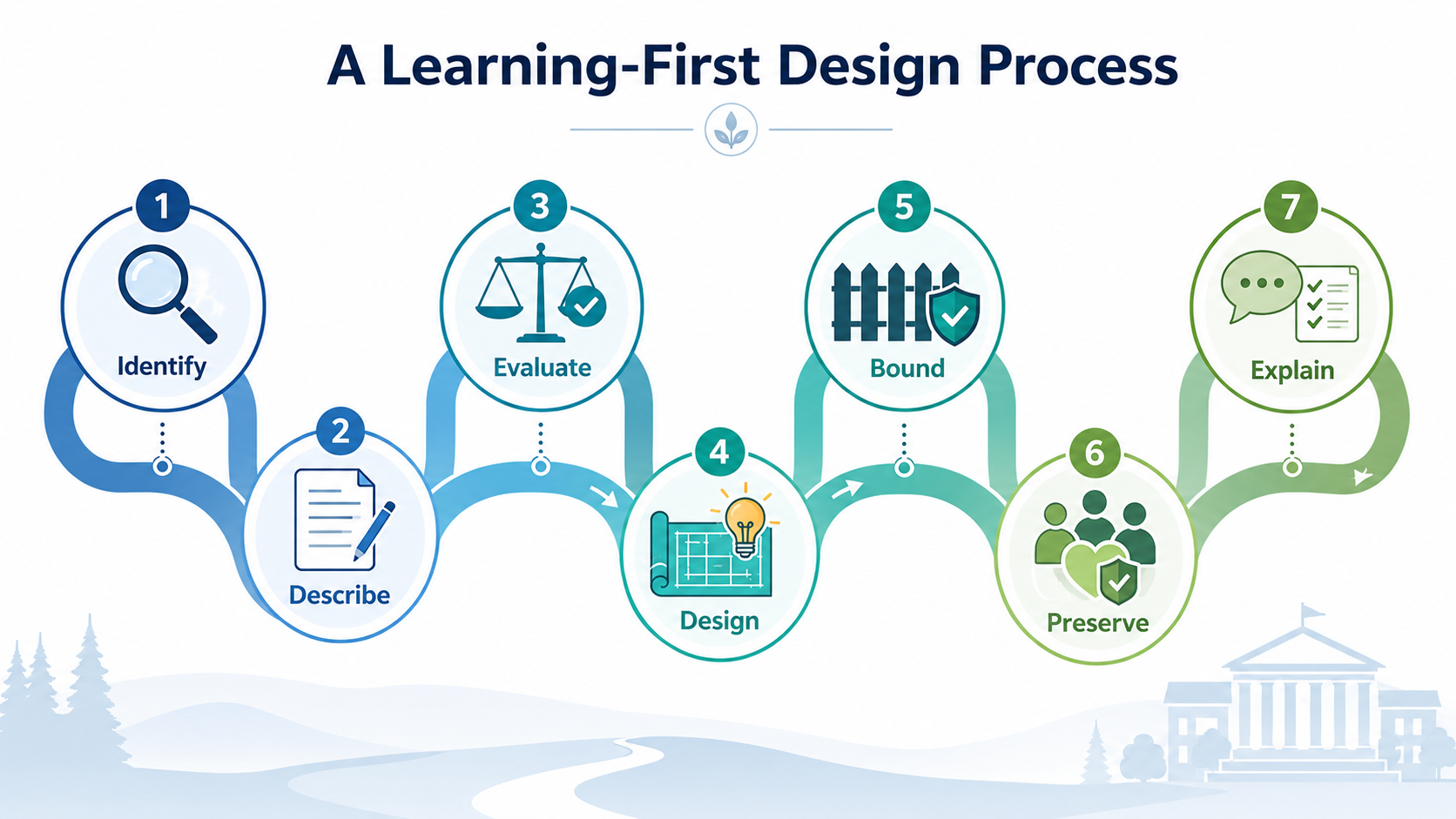
AIMON uses a seven-step design process:
1. Identify: When and where does the need arise?
Identify the learning context, the learners, and the moment when support may be needed.
2. Describe: What is the learner trying to accomplish, and what makes this moment difficult or important?
Clarify the learner task, existing support, the support gap, and what learning work should remain with the learner.
3. Evaluate: Is AI an appropriate form of support?
Compare AI with instructor, peer, non-AI, and combined support approaches.
4. Design: What support could help?
Develop or select support that fits the identified need rather than beginning with a preferred technology.
5. Bound: What should AI do, and what should it not do?
Define clear roles and limits so that support does not become substitution.
6. Preserve: How will the design protect what matters?
Consider learner thinking, productive struggle, agency, meaningful choice, access, transparency, and human connection.
7. Explain: Why this need? Why this support? Why this moment?
Make the reasoning behind the design visible and defensible.
What AIMON Is Trying to Preserve
AI can make support more responsive, individualized, and available at moments when an instructor or peer may not be immediately accessible.
But useful learning support should not come at the expense of the learning itself.
AIMON emphasizes several principles:
- Learning before tools
- People before technology
- Support rather than substitution
- Learner agency and meaningful choice
- Critical thinking and human judgment
- Access across learner pathways
- Reasoned non-use of AI when another support is better
A central question throughout the framework is:
What thinking, judgment, practice, interpretation, or creation should remain with the learner?
Learn and Apply AIMON
The HyFlex Learning Community currently offers two professional learning experiences for educators and designers who want to explore and apply these ideas.
The two experiences share many AIMON resources and design tools, but they support different participation needs.
AIMON Learning Design Studio
A Guided, Synchronous Design Experience
The AIMON Learning Design Studio is a collaborative professional learning experience for participants who want live facilitation, peer conversation, structured design work, and individualized support.
Participants bring a real course, assignment, workshop, or other learning context and work through the AIMON design process together.
The Studio typically includes:
- Live facilitated design sessions
- AIMON Opportunity Scan and Design Sketch activities
- Small-group peer consultation
- Worked examples and design resources
- Optional use of the AIMON Design Partner custom GPT
- An optional individual design consultation
The emphasis is on taking one meaningful learner-support challenge and developing a reasoned, practical support strategy.
Learn more about the AIMON Learning Design Studio →
[AIMON Learning Design Studio explanation
Designing on the Edge: Teaching Smarter with AI
A Flexible, Asynchronous Professional Learning Experience
Designing on the Edge provides a more flexible way to explore AI-supported learning and instructional design.
Participants work through examples, guided activities, AIMON resources, discussion opportunities, and design tasks on their own schedule.
The asynchronous pathway moves through four broad stages:
Explore → Locate → Evaluate & Design → Strengthen & Plan
Participants investigate practical uses of AI, identify an authentic learner-support need, evaluate AI alongside human and non-AI alternatives, and develop an initial AIMON Design Sketch and implementation direction.
This experience is especially useful for participants who want to explore broadly and work independently while still having access to shared resources, examples, peer interaction, and the AIMON Design Partner.
Learn more about Designing on the Edge →
[Insert Designing on the Edge page link]
Combine the Two Experiences
The two experiences may also be used together.
Designing on the Edge can provide a deeper asynchronous exploration and preparation layer, while the AIMON Learning Design Studio provides facilitated conversation, design critique, peer learning, and individual consultation.
Explore independently. Design with others. Refine with individual support.
[Insert combined offering or registration link, if applicable]
AIMON and Flexible Learning
AIMON has strong connections to the challenges that originally motivated HyFlex learning design. HyFlex expands learner access to participation across time, place, and mode. AIMON extends that question to learner support:
How can learners receive useful support across the different moments when they need it?
A learner participating asynchronously may encounter a problem at midnight. A student joining synchronously online may need a different form of support than someone sitting in the classroom. A learner may understand a concept during instruction but struggle later when applying it independently.
AIMON helps designers consider how support can travel across these different learner pathways. At the same time, the framework is not limited to HyFlex learning. AIMON can be applied to face-to-face, hybrid, online synchronous, online asynchronous, workplace, and professional learning environments.
AIMON Presentations, Publications, and Resources
AIMON continues to develop through teaching practice, professional learning, conference presentations, design experiments, and research.
This section will grow as additional resources become available.
Presentations and Recordings
AIMON Keynote — HyFlex Collaborative Conference 2026
An introduction to the AIMON framework and its connection to flexible, learner-centered support.
Watch the keynote:
https://youtu.be/Q6e1apDQQUo?t=964
AECT 2026
Additional AIMON presentations and resources from the 2026 Association for Educational Communications and Technology conference will be added here following the conference.
[Presentation links TBD in November 2026]
Papers and Publications
HyFlex Collaborative Conference 2026 Proceedings Paper
A proceedings paper associated with the AIMON keynote further develops the framework and its implications for learning design.
Additional AIMON Publications
Future papers, research reports, case studies, and related publications will be added here as they become available.
AIMON Blog Series
The HyFlex Learning Community blog includes a series of seven posts from 2026 exploring the AIMON framework, learning-support moments, design principles, and practical applications.
Start with the first AIMON post:
https://www.hyflexlearning.org/2026/03/25/aimon_1/
AIMON Design Resources
A growing set of practical resources has been developed to help educators and instructional designers apply the framework.
Current resources include:
- AIMON at a Glance
- AIMON Opportunity Scan
- Completed Opportunity Scan examples
- AIMON Design Sketch
- Completed AIMON Design Sketch examples
- Quick Practice: AI, Maybe, or Not AI?
- Peer Feedback Guide
- Resources for Using AI to Support Academic Learning
- Designed for the Moment: Custom GPTs for Learning and Learning Design
- AIMON Design Partner custom GPT
Some resources are currently provided through the AIMON professional learning experiences. Additional public resources will be added here as the framework continues to develop.
[Insert resource collection link, if available]
AIMON Design Partner
The AIMON Design Partner is a custom GPT designed to help educators work through the AIMON design process.
It can help users:
- Identify and clarify a learner-support need
- Develop an AIMON Opportunity Statement
- Evaluate whether AI is appropriate
- Compare AI, human, peer, and non-AI support
- Define roles and boundaries
- Review an emerging Design Sketch
- Plan a small implementation test
The Design Partner is designed to support professional thinking—not make design decisions for the user.
Explore the AIMON Design Partner:
https://chatgpt.com/g/g-6a72517899bc8191a98e47d8bafca826-aimon-design-partner
Stay Connected
AIMON is an evolving framework.
We are continuing to develop professional learning opportunities, design resources, examples, presentations, and research focused on one central challenge:
How can we provide learners with the right support at the right moment while preserving the thinking, agency, relationships, and human judgment that meaningful learning requires?
To learn more, participate in an upcoming AIMON experience, or discuss a customized professional learning opportunity for your institution or group:
Explore all of the HyFlex Learning Community Professional Development opportunities: https://www.hyflexlearning.org/workshops/
Explore Professional Development Opportunities at the HyFlex Learning Store: https://hyflexlearning.info
Contact the HyFlex Learning Community: [Contact Us form] or email: hyflexlearning@gmail.com
