
Since 2021, the HyFlex Learning Community has focused on creating a community resource portal helping educators design flexible learning experiences that expand access while preserving quality, connection, and learner choice. That work continues. But the landscape around us is changing, and the HyFlex Learning Community approach is adjusting in several ways to better fit this landscape.
Meaningful Shifts in Education
Faculty, instructional designers, trainers, administrators, and educational leaders are now navigating several overlapping shifts at once. Flexible participation is no longer only a temporary response to location disruption or declining enrollments. Online, hybrid, blended, HyFlex, synchronous, asynchronous, and multimodal learning environments are becoming part of the long-term design landscape, especially in higher education but also in some significant portion of K-12 education as well. At the same time, generative AI is reshaping conversations about course design, assessment, feedback, academic integrity, student support, professional practice, and the future of learning.
Recent higher education reports point to a sector navigating rapid change, including the growing influence of AI on teaching, assessment, instructional design, academic support, student–faculty relationships, workforce preparation, privacy, and student support (Gay & Muscanell, 2026; Robert, 2025; Robert et al., 2026). Global guidance on generative AI also emphasizes the need for human-centered, ethical, equitable, and pedagogically meaningful use of these technologies (Miao & Holmes, 2023).
For the HyFlex Learning Community, these changes reinforce a familiar but expanding question:
How do we design learning experiences that are flexible, accessible, human-centered, and responsive to learners’ real needs?
That question is shaping the next phase of our professional learning opportunities. (For a quick look at the HLC Workshop Series, see the Workshop Series page on the HLC site: https://www.hyflexlearning.org/workshops/
Our Workshop Series Is Evolving – Why?
The HyFlex Learning Community began with a clear commitment: supporting educators who wanted to design flexible, high-quality learning experiences across participation modes. HyFlex course design remains central to that mission. Learner choice, equivalent learning opportunities, reusable learning resources, and accessibility continue to matter.
But the work of flexible learning design is expanding.
Today, educators are not only asking how to support students across face-to-face and online pathways. They are also asking how to help learners navigate AI-supported tools, participate meaningfully across modes, receive timely feedback, build community, demonstrate learning authentically, and remain active agents in their own learning.
These are not separate challenges. They are connected parts of a broader design problem.
Flexible learning now requires more than choosing a delivery mode. HyFlex design has long emphasized learner choice, equivalent learning opportunities, reusable learning resources, and accessibility, which means that flexibility must be designed as a system rather than treated as a scheduling option (Beatty, 2014, 2019). More recent HyFlex research also points to the importance of instructor presence, interaction, feedback, belonging, and connection across participation modes, reminding us that flexible learning environments must support the human and relational dimensions of learning as well as access to content (Buckley et al., 2024).
The revised HyFlex Learning Community workshop series is designed to support educators at different points in this work.
Four Ways to Engage in Structured Professional Development
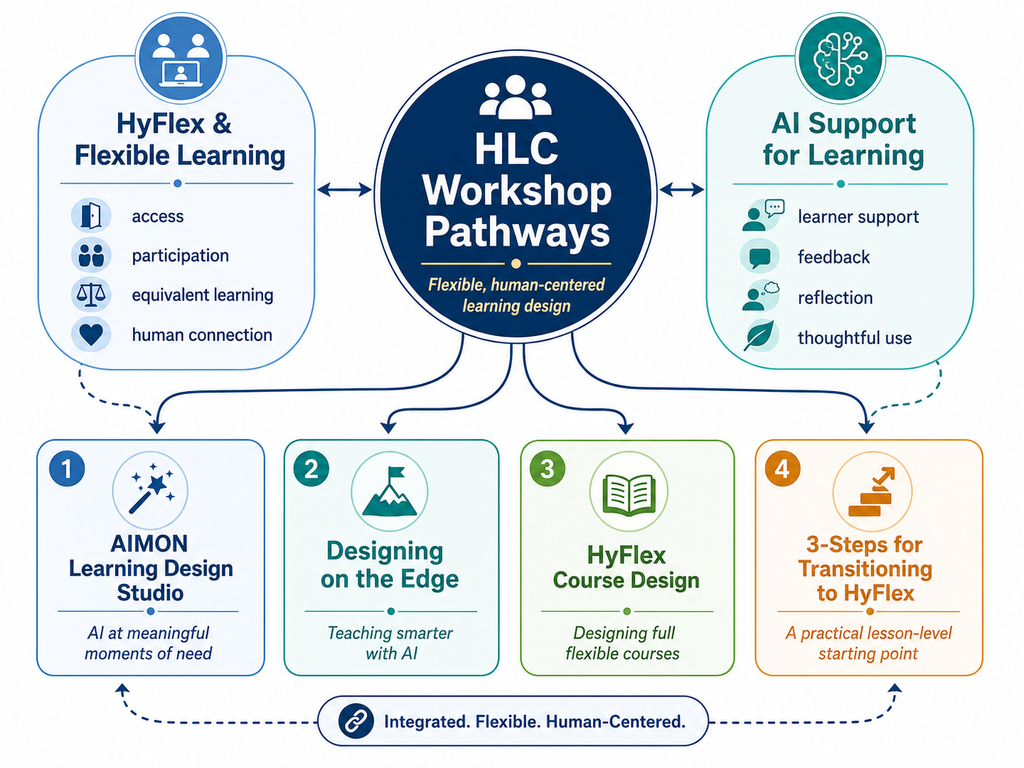
The current workshop offerings provide four entry points into flexible, human-centered learning design. Each workshop serves a different specific need with a unique but related purpose. All are connected by the same underlying commitment: better learning through thoughtful design.
The Newest Offering: AIMON Learning Design Studio
The AIMON Learning Design Studio is for faculty, instructional designers, trainers, and others who want to design practical AI-supported learning around authentic learner needs.
Rather than beginning with a tool or platform, the Studio begins with a learning moment. Participants bring a real course, assignment, workshop, or learning context and ask: Where do learners need support, and what form of support fits that moment?
Using the AIMON: AI in the Moment of Learning Need framework, participants identify meaningful points of learner need, examine existing support, consider AI alongside human and non-AI alternatives, and develop an initial design that preserves learner thinking, agency, access, and human connection. (Beatty, 2026a, 2026b)
This synchronous online workshop is especially useful for educators who are interested in AI but do not want to simply add more tools to their courses. The full workshop experience includes a follow-on one-one synchronous consultation with the facilitator.
The goal is not more AI. The goal is better learning support at the right moment.
Designing on the Edge: Teaching Smarter with AI
Launched in 2025, the Designing on the Edge workshop grew out of recent HLC conversations about AI-supported teaching and future-ready learning environments. In the 2025 HyFlex Collaborative Conference keynote, Partnering with AI: Shaping the Future of [HyFlex] Learning, Beatty framed AI as a growing partner in course planning, richer learning materials, accessibility support, student engagement, out-of-class learning support, and reflection on the human elements of teaching (Beatty, 2025). This workshop extends that conversation into a flexible, hands-on professional learning experience for faculty and instructional designers who want to explore how AI can support teaching, learning, assessment, feedback, and course design without losing sight of learner agency, equity, and human connection.
Like the AIMON Studio, Designing on the Edge uses a learner-first approach. Participants are encouraged to move beyond the question, “What can this AI tool do?” and ask a more useful design question: “Where do learners need support, and what form of support fits that moment?”
This workshop may be a good fit for educators who want time, examples, and practical activities to explore AI-supported teaching on their own schedule.
HyFlex Course Design
The HyFlex Course Design workshop remains the foundational professional learning experience for faculty and instructional designers who are designing full HyFlex courses. Over the past 15 years, thousands to faculty, designers, and other staff have completed this workshop to prepare for their own HyFlex course or program development. Many institutions have licensed the workshop materials to offer ongoing profressional development to their local stakeholders as well.
This workshop supports participants as they plan flexible student participation across multiple delivery modes, revise learning outcomes, identify content resources, plan engagement strategies, design assessment approaches, and consider how to evaluate the impact of HyFlex delivery on participation, achievement, and other goals.
The updated version now incorporates AI tools and generative AI support into the design process. Participants can explore how AI may support HyFlex planning, engagement, assessment, student preparation, and implementation across modes. The workshop also models how AI tools can support the learning process itself, while keeping the focus on effective course design. Examples from several years of designing, implementing, and teaching with custom AI tools in a variety of course contexts provide practical strategies and specific activities to spur participants’ creative design thinking.
This workshop is especially useful for educators and institutions preparing to implement HyFlex courses or programs in a thoughtful, sustained way.
3-Steps for Transitioning to HyFlex
Since 2023, the 3-Steps for Transitioning to HyFlex workshop has offered a focused, self-paced path for educators who want to begin their HyFlex design at the detailed lesson level.
Not everyone is ready to redesign an entire course at once. Sometimes the most practical starting point is one lesson, one learning activity, or one instructional sequence. This workshop helps participants transition a lesson from one delivery mode to another using a structured process: Document, Review and Revise, Complete and Extend.
Participants use templates and rubrics to examine an existing lesson, revise it for another mode, and consider how to support interaction, engagement, and equitable learning across delivery formats.
This workshop is especially useful for faculty, instructional designers, and professional development staff who want a concrete, manageable entry point into HyFlex design.
Choosing a Pathway
The revised workshop series is not a sequence everyone must complete in the same order. It is a set of pathways.
- Start with the AIMON Learning Design Studio if your main question is how to design AI-supported learning around meaningful moments of learner need. (synchronous)
- Start with Designing on the Edge if you want a broader, flexible exploration of AI for teaching, learning, assessment, engagement, and design. (asynchronous)
- Start with HyFlex Course Design if you are preparing to design or redesign a full HyFlex course. (synchronous or asynchronous participation available)
- Start with 3-Steps for Transitioning to HyFlex if you want to begin with a focused lesson-level redesign. (asynchronous)
Each pathway is different, but the deeper purpose is shared: helping educators design learning experiences that are flexible, accessible, thoughtful, and deeply human.
What Connects the Workshops
Across all four workshops, several commitments remain constant.
- We begin with learners, not tools.
- We design for access, participation, and meaningful learning.
- We treat flexibility as a design responsibility, not simply a scheduling convenience.
- We use technology thoughtfully, not automatically.
- We preserve human connection, educator judgment, learner agency, and academic rigor.
- We look for practical designs that educators can test, revise, and improve in their own contexts.
These commitments have always been part of the HyFlex Learning Community. What is changing is the range of learning environments, technologies, and learner needs we are now designing for.
Looking Ahead – Further Shifts Expected
This workshop evolution is part of a broader direction for the HyFlex Learning Community. HyFlex (Hybrid, Flexible learning) remains an important foundation, but the conversation is expanding.
In the coming year, we will continue exploring how flexible, multimodal, adaptive, accessible, and AI-supported learning environments can help educators meet learners where they are while preparing them for where they are going. This does not mean leaving HyFlex behind. Far from it. It means building on what HyFlex has taught us: that learners benefit when they have meaningful choices, equitable opportunities, reusable resources, accessible pathways, and strong learning support.
The work ahead is larger than any single mode or technology. It is about designing learning without unnecessary limits. And it begins with a practical question every educator can ask:
What kind of learning experience are my students ready for next, and what support will help them get there?
Visit the HyFlex Learning Workshops page to learn more about the current offerings and choose the pathway that fits your next design challenge. https://www.hyflexlearning.org/workshops/
References
Beatty, B. J. (2014). Hybrid courses with flexible participation: The HyFlex course design. In L. Kyei-Blankson & E. Ntuli (Eds.), Practical applications and experiences in K-20 blended learning environments (pp. 153–177). IGI Global.
Beatty, B. J. (2019). Hybrid-flexible course design: Implementing student-directed hybrid classes. EdTech Books. https://edtechbooks.org/hyflex
Beatty, B. J. (2025). Partnering with AI: Shaping the future of [HyFlex] learning [Keynote presentation]. HyFlex Collaborative Conference 2025, HyFlex Learning Community.
Beatty, B. J. (2026a). AI in the moment of learning need: Designing support for flexible learning pathways[Keynote presentation]. 2026 HyFlex Collaborative Conference: Reenvisioning HyFlex through AI and Other Emerging Technologies, online.
Beatty, B. J. (2026b). AI in the moment of learning need: Designing support for flexible learning pathways[Keynote presentation recording]. HyFlex Collaborative Conference. YouTube. https://youtu.be/Q6e1apDQQUo
Buckley, J. B., Thompson, A. K., Tretter, T. R., Biesecker, C., Robinson, B. S., & Hammond, A. N. (2024). “Where I feel the most connected:” Community of Inquiry supporting sense of belonging in a HyFlex engineering course. The Internet and Higher Education, 60, 100930. https://doi.org/10.1016/j.iheduc.2023.100930
Gay, K., & Muscanell, N. (2026, March 23). 2026 EDUCAUSE students and technology report: Steady through change. EDUCAUSE. https://www.educause.edu/content/2026/students-and-technology-report
Miao, F., & Holmes, W. (2023). Guidance for generative AI in education and research. UNESCO. https://doi.org/10.54675/EWZM9535
Robert, J. (2025, September 29). 2025 Horizon action plan: Building skills and literacy for teaching with GenAI. EDUCAUSE. https://library.educause.edu/resources/2025/9/2025-educause-horizon-action-plan-building-skills-and-literacy-for-teaching-with-genai
Robert, J., Muscanell, N., McCormack, M., & Arnold, K. (2026, May 18). 2026 EDUCAUSE Horizon report: Teaching and learning edition. EDUCAUSE. https://library.educause.edu/resources/2026/5/2026-educause-horizon-report-teaching-and-learning-edition