
Over the past several posts, I have explored how AI can support learners at different moments of need. The series began with a simple premise:
AI should not be used simply because it is available. It should be used when it helps learners do meaningful learning work.
That distinction matters.
It is easy to start with the tool. What can this AI system do? What can it generate? What can it automate? What new feature has appeared this week?
AIMON begins somewhere else… It begins with the learner.
What is the learner trying to understand? Where are they stuck? What kind of support would help them move forward? What should remain challenging, human, reflective, or social? What should AI support, and what should it leave alone?
Those questions have guided this series. They also point toward a larger claim: the future of AI in education should not be organized around better tools alone. It should be organized around better support for learning.
The goal is not better AI. The goal is better learning.
Care to listen? Take a few minutes to listen to a podcast-style audio discussing this distinction between an AI-tool focus and a learner-needs focus.
From Tools to Moments
The AIMON framework, or AI in the Moment of Learning Need, is influenced by the Five Moments of Need framework developed in the performance support literature (Gottfredson & Mosher, 2011). That framework helped shift attention from training as a one-time event to support that is available when people need to learn, apply, solve, change, or perform.
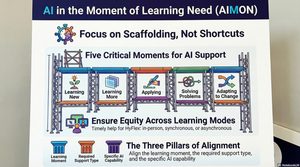
In education, a parallel set of moments appear throughout the learning process. Students encounter new ideas. They try to make sense of them. They apply what they are learning. They run into problems. They adapt to change. Eventually, if the learning continues, they begin to deepen their competence and move toward expertise.
Across this series, I have described these moments as part of a learning arc:
- Learners get started.
- Learners build understanding.
- Learners apply knowledge.
- Learners work through challenges.
- Learners adapt to change.
- Learners deepen expertise and continue learning.
The moments are not rigid steps. Learners may move back and forth among them. A student applying knowledge may suddenly realize they do not fully understand a concept. A student solving a problem may encounter a new perspective that requires adaptation. A student developing expertise may return again and again to earlier moments of understanding, practice, feedback, and revision.
That is part of the point.
Learning is not a straight line. It is a living process.
AI becomes useful when it supports that process rather than distracting from it.
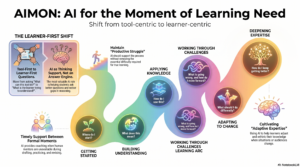
The Learning Arc
When learners are getting started, they often need orientation. They may not yet understand the expectations, vocabulary, structure, or purpose of a course or task. AI can help by answering basic questions, clarifying directions, reducing initial confusion, and helping learners see where to begin.
The key question is: Where do I start?
When learners are building understanding, they need more than definitions. They need explanations, examples, analogies, questions, and opportunities to test their emerging mental models. AI can help learners encounter ideas in multiple forms and check whether they can explain those ideas in their own words.
The key question is: What does this mean?
When learners are applying knowledge, they begin using ideas in context. They may be writing, designing, analyzing, building, presenting, or making decisions. AI can help them rehearse, compare options, receive feedback, and examine whether their work reflects the ideas they are trying to use.
The key question is: How do I use this?
When learners are working through challenges, something may not work as expected. Their argument may be unclear. Their design may not meet the need. Their analysis may reveal contradictions. AI can help learners slow down, diagnose the difficulty, consider alternatives, and decide what to try next.
The key question is: What is going wrong, and how can I move forward?
When learners are adapting to change, the challenge is different. They may encounter a new perspective, a new tool, or a new audience. Nothing has necessarily gone wrong, but something has changed. AI can help learners compare earlier and later thinking, examine tradeoffs, and decide whether adaptation is needed.
The key question is: What has changed, and what should I do differently?
Finally, learners deepen expertise when they continue beyond initial competence. They refine performance, seek feedback, practice intentionally, adapt to new conditions, and continue learning after the course, workshop, or assignment ends.
The key question is: How do I keep getting better?
A Story From Practice
Consider a small group of students in an upper-division social science course on community policy. Their project is to investigate housing affordability and present recommendations to a public audience.
At first, they think the work is mainly about data. They gather reports, compare rental costs, examine income levels, and build charts. Then they begin interviewing stakeholders: renters, small landlords, city staff, nonprofit advocates, and local business owners.
Their understanding changes.
The data still matter, but the students now see that different groups experience the same issue in different ways. The project is no longer only about housing prices. It is about people, priorities, tradeoffs, and lived experience.
Later, the team discovers new AI tools. NotebookLM helps them organize sources. Canva helps them create visuals. Generative AI helps them brainstorm presentation structures. At first, everything feels easier. Then their report becomes too long, their slides become too crowded, and their attention shifts from learning to producing more material.
They have gained new capability, but now they need judgment.
Near the end of the semester, the instructor announces that the final audience will include community members and local agency staff. The presentation they designed for classmates no longer fits. Their language is too academic. Their charts assume too much background knowledge. Their recommendations need to be communicated differently.
Nothing in the project has “failed.”
But the students have moved through several moments of need. They built understanding, applied knowledge, encountered new perspectives, evaluated new capabilities, and adapted to a new context.
In the process, they learned something larger than the content of the assignment.
They learned that knowledge becomes more powerful when learners can revise, apply, question, and adapt it.
The Pattern Across the Series
Looking back across the series, several patterns become clear.
First, the most valuable AI support is often not answer-giving. It is thinking support.
AI can generate answers, of course. Sometimes that is useful. But in learning contexts, the more important role is often helping students ask better questions, compare possibilities, explain their reasoning, notice gaps, reflect on feedback, and try again.
Second, the same AI tool can support very different learning needs.
A chatbot might help one student understand a confusing concept, another rehearse an explanation, another diagnose a problem, and another reflect on a changed perspective. The tool alone does not define the learning value. The moment matters.
Third, AI support should not remove all difficulty.
Some difficulty is part of learning. Students need opportunities to struggle productively, make decisions, test ideas, revise their thinking, and develop confidence in their own judgment. If AI removes too much of that work, it may produce smoother artifacts while weakening learning.
Fourth, the learner must remain the agent of learning.
AI can support, prompt, question, summarize, simulate, critique, and coach. But learners still need to decide what matters, what to trust, what to revise, and how to act. A learner-centered approach to AI does not ask, “How much can the tool do?” It asks, “What kind of learning work should the learner still do?”
That is one of the central insights of AIMON.
Beyond Competence
Many courses are designed around competence. Students should be able to explain a concept, use a method, complete a project, pass an assessment, or demonstrate a skill.
Competence matters. Learners need it.
But competence is not the end of learning.
In many fields, the more important question is what learners do after they become basically capable. Do they keep improving? Do they seek feedback? Do they notice when familiar approaches no longer fit? Do they adapt when circumstances change?
This is where the concept of adaptive expertise becomes especially useful.
Hatano and Inagaki (1986) distinguished between routine expertise and adaptive expertise. Routine expertise involves efficient performance in familiar situations. Adaptive expertise involves the ability to adjust, rethink, and extend knowledge when situations change.
That distinction helps explain why the final moment in the AIMON learning arc matters.
A learner who has developed routine competence may know how to complete a familiar task. A learner developing adaptive expertise can ask whether the task, context, audience, evidence, or constraints have changed in ways that require a different approach.
Adaptive expertise does not mean constantly changing everything. It means knowing when change matters.
It also means recognizing that expertise is not simply the accumulation of answers. Expertise includes judgment, reflection, flexibility, and continued learning.
Deliberate Practice and the Coaching Gap
The concept of deliberate practice adds another important layer.
Research on expert performance suggests that expertise does not usually develop through experience alone. It develops through focused effort, feedback, reflection, and repeated attempts to improve performance over time (Ericsson et al., 1993).
In many fields, deliberate practice depends on coaching. A coach, teacher, mentor, supervisor, or experienced practitioner observes performance, identifies areas for improvement, suggests strategies, and helps the learner practice more effectively.
That kind of support is powerful.
It is also unevenly available.
Not every learner has access to an expert coach. Not every student receives feedback when they need it. Not every professional has someone nearby who can help them reflect, practice, and improve at the moment a need arises.
This is one of the places where AI may become especially important.
AI should not be treated as a replacement for expert human coaching. Human coaches bring experience, care, contextual understanding, accountability, and professional judgment that AI cannot fully reproduce.
But AI can support some coaching functions when human support is unavailable. It can help learners rehearse explanations, generate practice scenarios, compare versions of their work, ask reflective questions, identify possible weaknesses, and suggest areas for revision.
In this sense, AI may help extend access to practice support.
Not perfect support. Not complete support. But timely support.
That matters because learners often need help between formal teaching moments. They need support while drafting, practicing, revising, preparing, experimenting, and trying again. These are precisely the moments when AIMON becomes useful.
What AI Can Support as Learners Keep Growing
If we think about AI as part of deliberate practice and adaptive expertise, several roles become clearer.
AI can be a practice partner. Students can rehearse a presentation, respond to simulated questions, practice explaining an idea, or test whether they can apply a concept in a new situation.
AI can be a feedback partner. Students can ask for feedback on clarity, alignment, organization, tone, evidence, accessibility, or audience fit. They can compare feedback from AI with feedback from peers, instructors, or clients.
AI can be a reflection partner. Students can revisit earlier work and ask what has changed in their thinking. They can examine decisions, assumptions, tradeoffs, and patterns in their learning.
AI can be a perspective partner. Students can explore how different stakeholders might interpret an issue, how an audience might respond, or how a decision could create unintended consequences.
AI can be a design partner. Students can generate alternatives, test ideas, and evaluate whether those ideas fit the learning goal, user need, ethical constraint, or performance context.
In each case, the value of AI depends on how it is used.
The point is not to make learners dependent on AI.
The point is to help learners practice the kinds of thinking they need to carry forward.
The Role of the Human Teacher
A learner-centered approach to AI does not reduce the importance of teachers. It makes the teacher’s design role more important.
Faculty and instructional designers decide where AI support belongs, where it does not belong, and how students should use it responsibly. They decide which moments need explanation, which need practice, which need feedback, and which need human connection.
They also help students learn how to judge AI output.
That may be one of the most important new teaching responsibilities in AI-supported learning environments. Students do not only need access to AI. They need guidance in deciding when AI is useful, when it is misleading, when it is unnecessary, and when it may interfere with learning.
Instructors can help by asking design questions such as:
Where do students typically get confused?
Where do they need practice?
Where do they need feedback sooner than I can provide it?
Where do they need to hear from peers or people with lived experience?
Where should AI support reflection rather than production?
Where should the task remain deliberately difficult?
These are not tool questions. They are learning design questions.
That is why AIMON belongs in the work of teaching and instructional design, not just in conversations about educational technology.
What Students Need to Learn About AI
Students also need a way to think about AI that goes beyond efficiency.
If students understand AI only as a shortcut, they may use it to avoid learning. If they understand AI only as a production tool, they may generate more content without developing stronger judgment. If they understand AI only as an answer engine, they may miss its potential as a partner for practice, reflection, and sense-making.
AIMON offers students a different question:
What kind of help do I need right now?
Do I need orientation?
Do I need explanation?
Do I need practice?
Do I need feedback?
Do I need help diagnosing a problem?
Do I need another perspective?
Do I need to adapt my work for a new context?
Do I need to reflect on how I am improving?
These questions help students use AI more intentionally. They also help students remain responsible for their own learning.
Would AI help you as a personal learning coach?
A Different Question for AI in Education
Much of the public conversation about AI in education begins with the question:
How can we use AI?
That question is understandable, but it is not sufficient.
AIMON asks a different question:
How can AI support learners at meaningful moments of need?
The difference is subtle but important.
The first question begins with the technology. The second begins with the learner.
The first question can lead to novelty, automation, and tool adoption. The second leads to learning design, support, judgment, and care.
This shift matters because AI capabilities will continue to change. The tools available today will not be the tools available next year. New systems will generate better text, images, audio, video, simulations, tutoring interactions, and feedback. Some will be useful. Some will be distracting. Some will create new opportunities. Some will create new risks.
A framework organized around tools will quickly become outdated.
A framework organized around learning needs has a better chance of lasting.
Beyond the Course
Although this series has focused largely on education, the underlying idea extends beyond formal courses.
Professionals also encounter moments of need. They begin new roles, learn new systems, apply knowledge in changing environments, solve unexpected problems, adapt to new tools, and continue developing expertise over time.
Faculty experience these moments as well. So do instructional designers, administrators, healthcare workers, engineers, artists, community organizers, and leaders.
The question is not only how AI can help students complete assignments.
The larger question is how AI can support people as they continue learning throughout their lives.
That is where AIMON becomes more than a strategy for classroom tool use. It becomes a way of thinking about learning support in a changing world.
Try This
Think about a course, workshop, training program, or professional learning experience you support.
Choose one important learning task.
Then ask:
- Where do learners need help getting started?
- Where do they need help building understanding?
- Where do they need practice applying knowledge?
- Where do they encounter problems or uncertainty?
- Where do they need to adapt to new perspectives, tools, or contexts?
- Where do they need feedback and practice to keep improving?
Now ask one more question:
- Which of these moments might AI support, and which should be supported by people, peers, communities, or experience?
That final question and its answer(s) are essential.
AIMON is not about inserting AI into every moment. It is about designing support wisely.
Key Insight
The goal is not to move learners through the moments once.
The goal is to help learners become more capable of navigating those moments throughout their lives.
AI matters only to the extent that it supports that larger purpose.
Closing
This series began with a strong focus on using AI, but it ends with a specific primary focus on learning first.
That feels right. The most important question for us as designers and teachers is not whether or how AI will become more powerful. It will, and we can’t fully predict how.
The more important question is whether we will use that power to support the kinds of learning we value: curiosity, understanding, practice, judgment, reflection, adaptation, expertise, and continued growth.
If we keep the learner at the center, AI can become more than a tool for producing answers. It can become part of a broader support system for learning at the moments when learners need help most.
That is the promise of AIMON.
Not better AI for its own sake.
Better learning.
References
Bransford, J. D., Brown, A. L., & Cocking, R. R. (Eds.). (2000). How people learn: Brain, mind, experience, and school (Expanded ed.). National Academy Press.
Ericsson, K. A., Krampe, R. T., & Tesch-Romer, C. (1993). The role of deliberate practice in the acquisition of expert performance. Psychological Review, 100(3), 363-406. https://doi.org/10.1037/0033-295X.100.3.363
Gottfredson, C., & Mosher, B. (2011). Innovative performance support: Strategies and practices for learning in the workflow. McGraw-Hill.
Hatano, G., & Inagaki, K. (1986). Two courses of expertise. In H. Stevenson, H. Azuma, & K. Hakuta (Eds.), Child development and education in Japan (pp. 262-272). W. H. Freeman.