
In the years immediately following the COVID-19 pandemic, HyFlex research has entered a noticeably different phase than 2020-2023 or even pre-2020. The literature published after the COVID-19 pandemic (and its long direct impact on higher education practice) from 2024 through early 2026 reflects a field no longer preoccupied with emergency response, rapid modality shifts, or crisis-driven continuity. Instead, researchers are returning deliberately and productively to many of the same questions that motivated and animated HyFlex scholarship before the pandemic. But now this research is informed by several additional years of sustained, large-scale implementation.
This return is not a step backward. During the pandemic, HyFlex demonstrated its capacity to support continuity, quality learning experiences, and more equitable access under extreme conditions. As a result, its value to higher education is no longer broadly in question. What is increasingly examined are the nuanced aspects of design, teaching, learning, and institutional support that determine when and how HyFlex works well. The growing volume and depth of post-pandemic research reflects both confidence in the approach and recognition that significant design and research questions remain.
Across recent HyFlex scholarship, four interrelated themes stand out to me. All of the works cited in this post are included in the HyFlex Learning Community Bibliogrpahy list (https://hyflexlearning.org/bibliography).
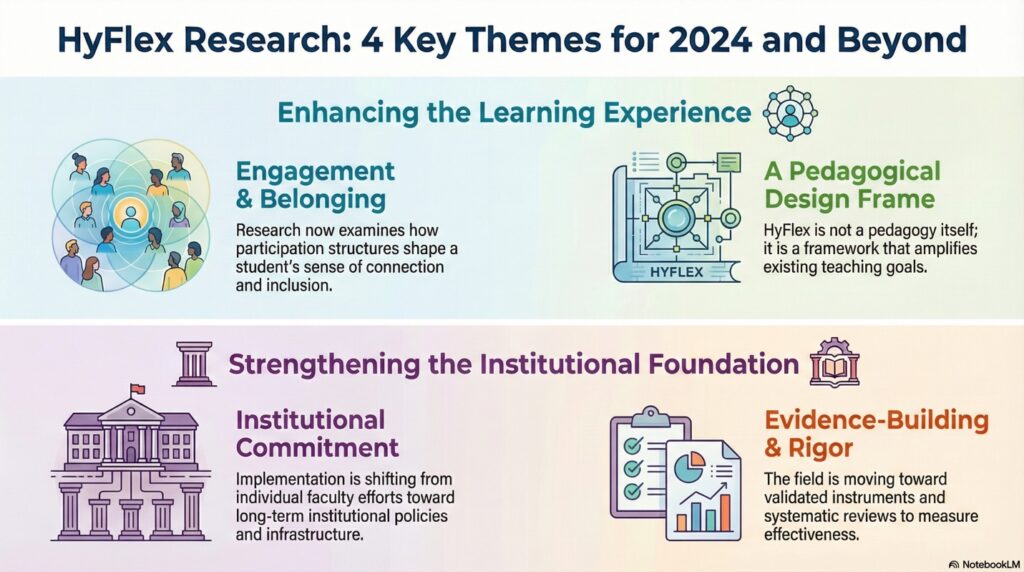
Theme 1. Engagement, Belonging, and the Quality of Participation
One of the most prominent themes in post-pandemic HyFlex research revisits long-standing concerns about student engagement, social presence, and belonging. These topics were already central to HyFlex scholarship before 2020. Rather than asking whether HyFlex students can participate effectively, recent studies examine how participation is experienced across modalities and how design choices shape students’ sense of connection and inclusion.
Several studies focus explicitly on engagement patterns (similar to early HyFlex research) and motivational dynamics in HyFlex environments. Baker et al. (2024) emphasize that engagement in HyFlex courses is shaped by students’ perceptions of choice, disruption, and agency rather than modality alone. Similarly, Bockorny et al. (2024) highlight the role of intrinsic motivation and instructional structure in sustaining participation across flexible pathways. Other work draws attention to students’ sense of belonging, showing that feelings of connection vary across participation modes and are strongly influenced by course design decisions (Buckley et al., 2024).
Comparative analyses further suggest that engagement challenges in HyFlex are not inherent to flexibility itself but emerge when participation structures privilege one group of learners over others (Bozan et al., 2024). Collectively, this research reframes engagement as a design outcome rather than a technological affordance. In reality, I believe it is a mixture of both.
Theme 2. Implementation Realities and Institutional Conditions
A second theme reflects a renewed focus on implementation, which is now grounded in a much broader empirical base than was available before or during the pandemic. Post-pandemic studies increasingly treat HyFlex as an institutional and organizational commitment rather than an individual instructional choice. Though there are likely still many faculty using HyFlex approaches on their own, the pandemic forced many institutions to provide faculty and student support much more broadly which has led to a greater commitment for the long term in many places.
Research conducted in community colleges and regional universities highlights the complexity of sustaining HyFlex teaching over time. Barr and Luo (2024) document faculty challenges related to workload, instructional coordination, and support structures, emphasizing that successful HyFlex implementation depends on institutional investment rather than individual faculty resilience. Similarly, Morrison et al. (2024) identify recurring implementation hurdles alongside instructional benefits, underscoring the importance of aligned policies and infrastructure.
Longer-term and context-specific analyses reinforce these conclusions. Morris (2025), for example, shows how institutional conditions, including scheduling systems, technical infrastructure, and professional support, shape HyFlex viability in Caribbean higher education. Administrative and operational perspectives, such as those examined by LeBlanc et al. (2024), further reveal how logistical systems (e.g., scheduling and room management) influence the feasibility of HyFlex at scale.
Together, these studies return HyFlex research to a pre-pandemic concern with sustainability but that is now supported by years of lived institutional experience.
Theme 3. HyFlex as a Pedagogical Design Frame, Not a Pedagogy
Another clear trend in recent research is the repositioning of HyFlex as a design frame that supports particular pedagogical approaches rather than as a pedagogy in its own right. Across disciplines, researchers examine how HyFlex interacts with instructional goals, materials, and learning activities.
Several studies focus on discipline-specific implementations, including language learning and literacy development. Oliwa (2024) provides practical guidance for adapting HyFlex to language instruction, emphasizing the need for materials and activities that function coherently across participation modes. Similarly, Oktariyani et al. (2024) and Intasena and Worapun (2024) examine HyFlex-based instructional designs aimed at improving reading comprehension, demonstrating how flexible participation must be carefully aligned with pedagogical intent.
Other research explores HyFlex as a means of extending authentic learning opportunities. Perius (2024), for example, describes how HyFlex supported global guest speaker engagement in an international business course, highlighting the pedagogical possibilities enabled by flexible participation. In agricultural education, Conde et al. (2024) show how modified HyFlex models can support disciplinary learning goals when thoughtfully contextualized.
Across these studies, a consistent conclusion emerges: HyFlex does not replace pedagogy; it amplifies it.
Theme 4. Evidence-Building and a Maturing Knowledge Base
Finally, a growing body of post-pandemic research focuses on consolidating knowledge about HyFlex through systematic reviews, validated instruments, and comparative outcome studies. This work marks a return to foundational research questions about effectiveness, experience, and learning outcomes which is now addressed with greater methodological rigor in many studies.
Romero-Hall et al. (2025) synthesize a decade of HyFlex research, identifying recurring themes, methodological patterns, and mixed findings across contexts. Rather than portraying HyFlex as universally beneficial, the review emphasizes conditional success tied to design quality and institutional support. Complementing this work, recent studies examine psychological needs satisfaction, engagement, and academic performance across HyFlex and face-to-face environments, offering more nuanced insights into learning outcomes (e.g., post-pandemic comparative studies reported in 2025).
Related to this theme of evidence-building, instrument development is beginning to feature more explicitly in post-pandemic HyFlex research, with a small but notable set of studies focused on validated measures of student perceptions, instructor support, and engagement (e.g., Ueoka & Nakatou, 2024; Romero-Hall et al., 2025). These efforts signal an early shift away from advocacy-oriented reporting toward more sustained, evidence-informed inquiry.
So where are we now? A Field Re-Centered on Design, Teaching, and Learning
Taken together, post-pandemic HyFlex scholarship reflects a field (our field, indeed!) that has regained its conceptual footing. Researchers are no longer focused on proving that HyFlex can function under crisis conditions. Instead, they are returning to and deepening pre-pandemic questions about engagement, pedagogy, implementation, and evidence, now informed by a far richer experience base.
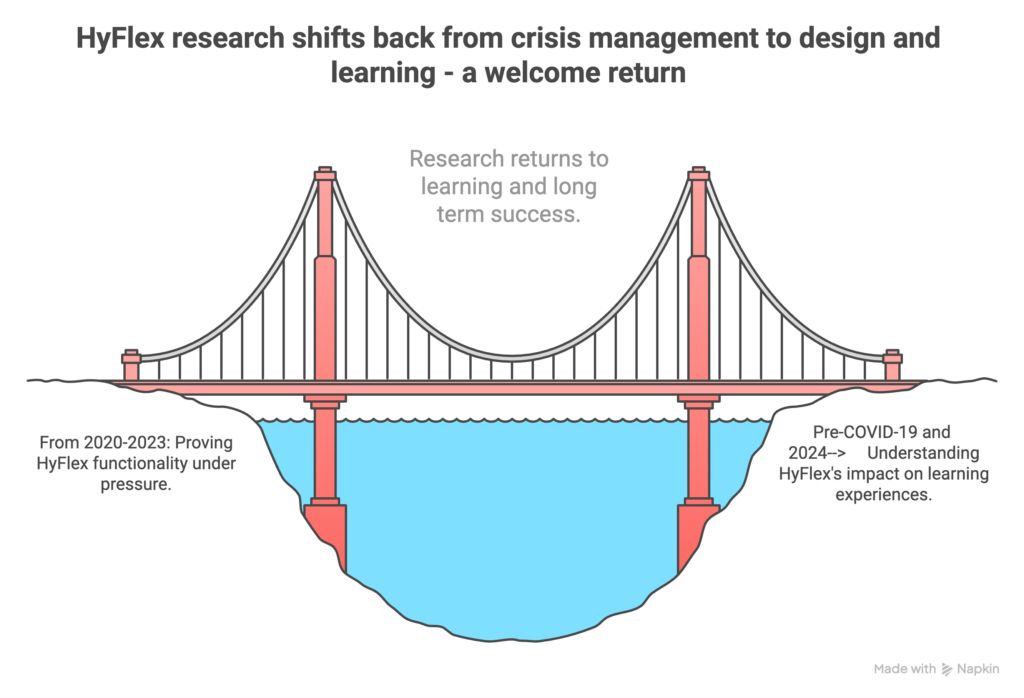
This renewed focus signals maturity rather than retreat. With HyFlex’s overall value and efficacy no longer broadly contested, research attention has shifted to understanding how flexible participation shapes learning experiences and how design and institutional choices determine success. For many educators, designers, and researchers around the world, HyFlex is no longer an experiment. It is an evolving design space that continues to reward careful study and intentional practice.
References (see https://hyflexlearning.org/bibliography for DOI links where available)
Baker, R. S., et al. (2024). Rethinking student engagement in HyFlex learning environments. Computers & Education, 198, 104738.
Barr, M., & Luo, T. (2024). HyFlex course design in community colleges: Faculty challenges, strategies, and supports. Community College Journal of Research and Practice, 48(4), 267–283.
Bockorny, K., et al. (2024). Intrinsic motivation and engagement in HyFlex classrooms. Educational Technology Research and Development, 72(3), 1509–1527.
Bozan, K., et al. (2024). Student engagement in HyFlex and online learning environments. Online Learning, 28(2), 34–52.
Buckley, A., et al. (2024). “Where I feel the most connected”: Belonging and presence in HyFlex engineering education. Journal of Engineering Education, 113(2), 456–478.
Conde, J. L., Meneses, J. H., Mercine, J. H., Ayo, J. P. D., & Dio, R. V. (2024). Towards the Preparation of Modified HyFlex Learning Scheme: The Case of University Agriculture Courses in the Philippines. International Journal of Instruction, 17(2), 651–666.
Intaena, P., & Worapun, W. (2024). Exploring the Efficacy of HyFlex Learning for Enhancing Reading Comprehension Skills of Secondary School Students: A Research and Development Study. International Journal of Learning, Teaching and Educational Research, 23(1), 24–38.
LeBlanc, H., et al. (2024). Administrative and operational considerations in HyFlex scheduling systems. Journal of Higher Education Policy and Management, 46(1), 89–104.
Morris, R. J. (2025). Factors impacting HyFlex implementation in Caribbean higher education (Doctoral dissertation).
Morrison, D., et al. (2024). Successes and hurdles of HyFlex undergraduate education. Innovations in Education and Teaching International, 61(2), 165–177.
Oktariyani, O., Dewanti, R., & Rasyid, Y. (2024). Prototype of English reading teaching materials based on the HyFlex model. International Journal of Advanced and Applied Sciences, 11(11), 118–129.
Oliwa, M. (2024). Contextualsing HyFlex learning for language education. Computer Assisted Language Learning, 37(5), 789–809.
Perius, J. (2024). Synchronous global engagement through HyFlex course design. Journal of International Business Education, 19, 113–127.
Romero-Hall, E., Allen, E., Duan, Y., & Morris, A. A. (2025). A decade of HyFlex learning: A systematic review. Educational Technology Research and Development, 73(1), 1–29.
Ueoka, S., and Nakatou, M. (2024). The Difference in Learning Effectiveness between HyFlex Training Modes. Japan Journal of Educational Technology, 47090.