
This post is the first in an eight-part blog series exploring AI in the Moment of Learning Need (AIMON – I treat the “L” as invisible). Over the next several weeks in the HyFlex Learning Community blog, I’ll introduce the core framework, share the design principles behind it, and illustrate how it can support teaching and learning through concrete examples from my own courses and custom GPTs and GenAI prompts. My hope is that each post will offer both a useful idea and an actionable takeaway for faculty and instructional designers working to design more effective learning experiences.
Quick Audio Overview (created with NotebookLM; less than 2 minutes):
Our audience matters here, and that shapes this series about using GenAI (AI) in our design work, our teaching, and in support of student learning. Readers of the HyFlex Learning Community blog are often thinking not only about whether a new practice is promising, but whether it can support high-quality and equitable learning opportunities for students in every participation mode. That is one reason I believe AIMON is worth exploring in this space. When used intentionally, AI can help us scaffold learning at key moments in ways that support students whether they are participating in person, online synchronously, or asynchronously.
A Common Question for Today
There’s a question I hear often now in conversations with faculty and instructional designers:
What should we do about AI?
Sometimes the question is about policy: what to allow, what to restrict. Sometimes it is about tools: what to recommend, what to avoid. But underneath those questions is a deeper design problem: not just whether students should use AI, but when and how AI actually helps learning.
In my own work as higher ed faculty (and in earlier roles as a high school teacher, a Navy officer responsible for training in a nuclear propulsion environment, an e-learning designer, a higher education senior administrator, and academic department chair), I have seen a recurring pattern. When new productivity and learning tools arrive, we tend to focus first on what they can do. Often, it is only later that we ask when and why they actually help people learn. This decades long arc of experience across classroom teaching, training, instructional design, and academic leadership has shaped how I think about support for learning over time, including the need to connect help to real moments of need in authentic work and study settings.
The shift from capability to timing is where this series begins.
From Tools to Moments of Learning Need
The approach I have been developing, which I call AI in the Moment of Learning Need (AIMON), is grounded in the Five Moments of Need framework developed by Conrad Gottfredson and Bob Mosher (Gottfredson & Mosher, 2011). The framework identifies five recurring points when people need support: 1) when they are learning something for the first time, 2) learning more, 3) trying to apply what they know, 4) solving a problem when something goes wrong, and 5) adapting to change. In workplace learning, this framework has been used to shift attention from content delivery alone toward support that improves performance in the flow of work.
AIMON adapts that underlying idea for course and program design.
Instead of asking only, Should students use AI? AIMON asks a more useful design question:
At what moments in the learning process would AI actually help, and how should that support be shaped?
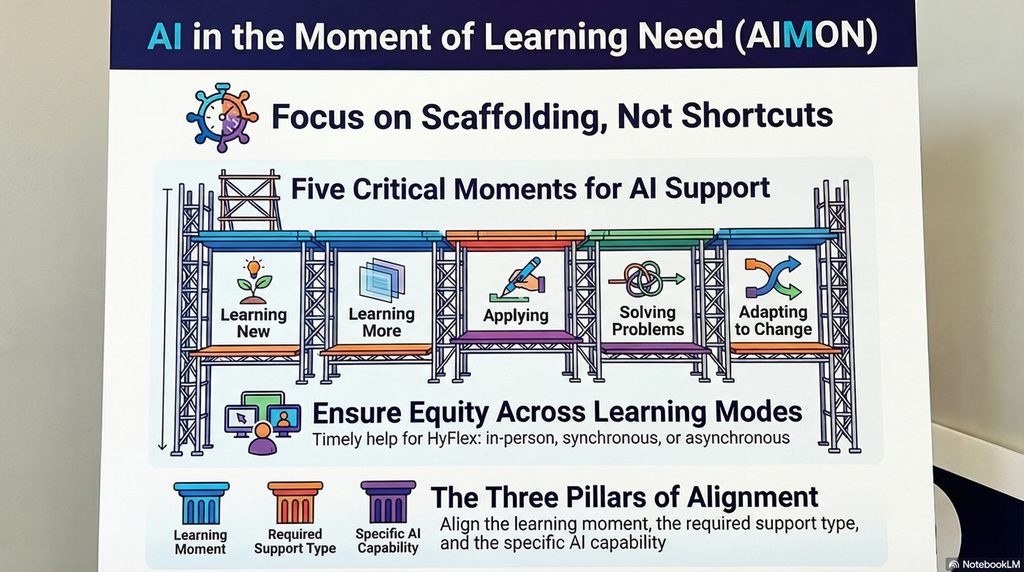
Answering this question is especially important in HyFlex contexts. Students engaging through different participation modes do not experience the course in exactly the same way or even at exactly the same time. But they do encounter comparable moments of need: getting oriented, making sense of new ideas, applying concepts, recovering from confusion, revising work, and adapting their understanding. If we design AI support around those moments, rather than around the tool(s) itself, we are more likely to support access, quality, and equity across modes.
What learners actually need before we think about AI
At each point in a course, students are not simply completing tasks. They are working through specific learning challenges.
At the beginning, they often need clarity, direction, and confidence. As they encounter new content, they need help making sense of unfamiliar ideas and connecting them to what they already know. As they apply concepts, they need space to test thinking, ask questions, and work through uncertainty. As they create work, they need feedback and opportunities to revise. As they reflect, they need ways to judge their own progress and identify what still needs work.
This is where the language of scaffolding is useful. In a classic formulation, Wood, Bruner, and Ross described scaffolding as a process in which support enables a learner to carry out a task or solve a problem beyond what they could do independently. The important idea is not just “help,” but help that is responsive, temporary, and oriented toward growing the learner’s capability (Wood, Bruner, & Ross, 1976).
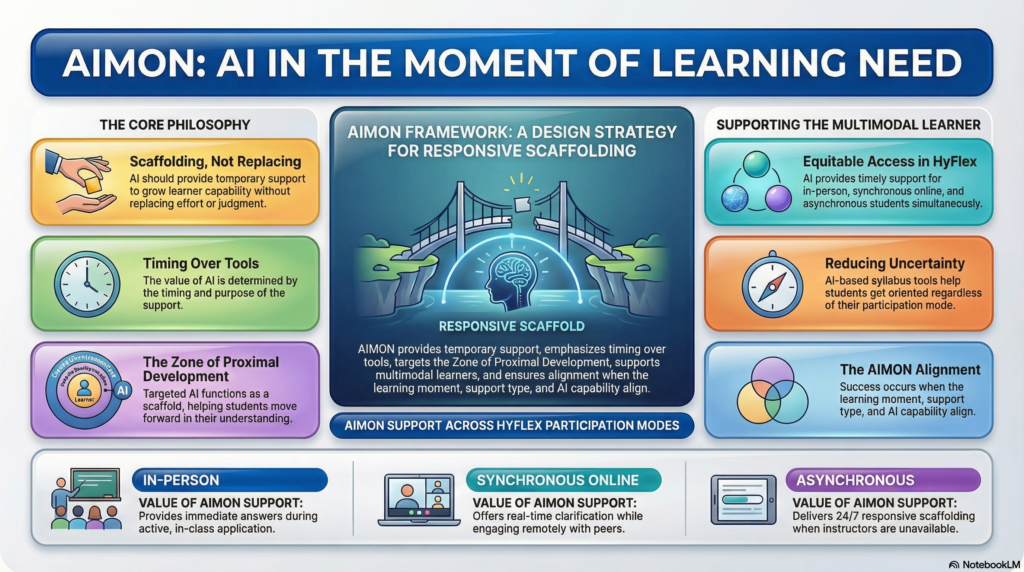
This idea is closely related to Zone of Proximal Development, introduced by Vygotsky (1978), which describes the space between what a learner can do independently and what they can do with appropriate support. Targeted use of AI can function as a form of scaffolding within that zone, helping students move forward in their understanding and gradually expand their capabilities over time, rather than simply providing answers.
That is the educational role I see AI potentially playing in AIMON: not replacing effort or judgment, but providing scaffolding at the moments when learners are most likely to benefit from it.
Where AI fits, and where it does not
AI can be quite effective at certain forms of scaffolding and targeted learning support. It can explain an idea in another way, provide examples, prompt reflection, help students compare alternatives, or offer feedback on a draft. In a HyFlex course, it can also provide timely support to students who are not present in the same mode at the same time as the instructor or their peers, which makes it especially relevant for multimodal learning environments.
But AI is not inherently aligned with learning.
Without clear design, AI can answer too quickly, generate text students have not really thought through, or create the illusion of understanding. Used that way, it may help students finish a task while weakening the learning the task was meant to support.
The key difference is not the tool. It is the timing, purpose, and design of the support.
A brief example from practice
In all of my courses, both graduate and undergraduate, I introduce a simple AI-based support tool to help students navigate the syllabus during the first week. Students could ask about deadlines, expectations, participation, and assignment structure and receive immediate guidance. The purpose is not to replace the syllabus, or the need for that first week “getting started in this class” discussion, or to reduce student responsibility. The purpose is to scaffold a very specific moment of need: reducing uncertainty at the beginning of the course so students could get oriented and move forward more confidently. In HyFlex courses, I also introduce another AI tool to help students decide which course participation mode may be the best choice for them in any given week. (I’ll say more about these tools in a later post in this series focused on this particular moment of need.)
That kind of support matters in many course formats, but it can be especially valuable in HyFlex and online environments, where students may encounter that uncertainty from different participation modes and on different timelines. A student attending live in person, a student joining synchronously online, and a student participating asynchronously may all need the same clarity, but they may not be able to access that support in the same way or at the same moment.
Earlier in my career, in a much more structured training environment, the same basic principle held. Support had to match the learner’s moment of need. Giving someone an answer about operating a nuclear power ship propulsion plant without building understanding was not enough. The question (even in the last century!) was always what kind of support would help them perform now while also strengthening future capability. That principle has stayed with me across teaching, training, and instructional design work.
Why this works
What AIMON does is align three things that are too often disconnected:
* the moment in the learning process
* the kind of scaffolding or support learners need at that moment
* the capabilities of AI tools
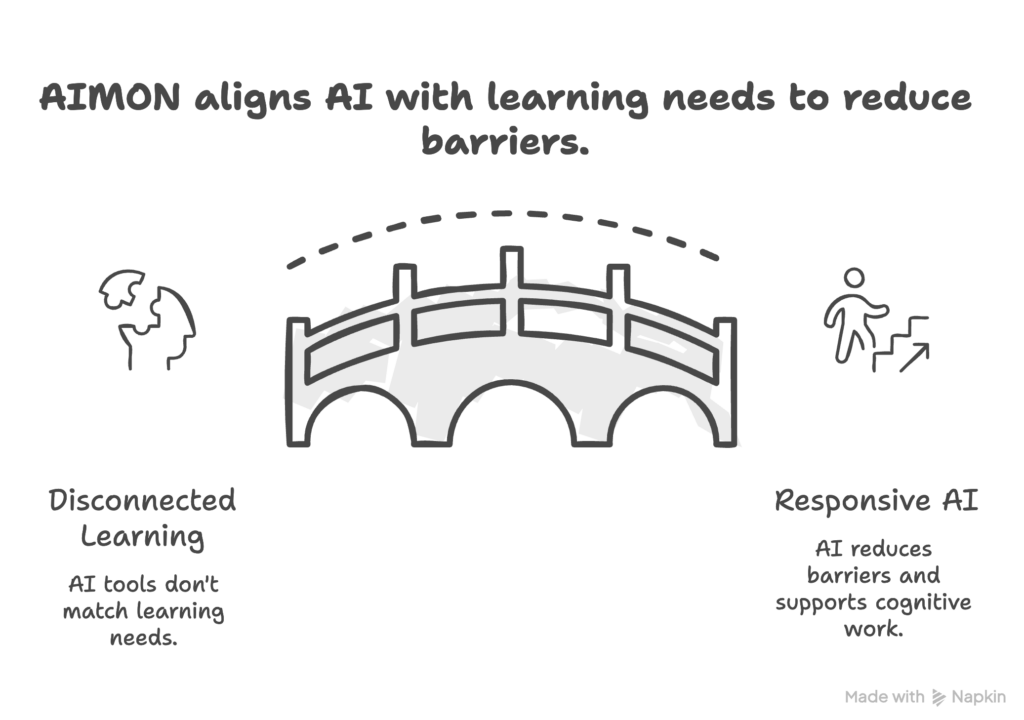
When those three align, AI can reduce unnecessary barriers while still preserving the cognitive work students need to do. It can help students get unstuck, deepen understanding, and continue moving forward without taking over the learning process.
That matters in any course. In HyFlex learning environments, it matters even more, because one of our central design challenges is to support students well across multiple participation options without lowering expectations or creating inequitable learning conditions. AIMON offers one way to do that: by designing support around shared moments of learning need rather than around a single delivery mode.
In that sense, the promise of AI is not primarily that it is powerful. It is that, when thoughtfully designed, it can help us scaffold learning in more responsive ways.
Beyond any one course
Although my examples in this series will come from my own teaching and use of custom GPTs, the larger idea is broader than any one tool or course. Faculty, instructional designers, and trainers all face versions of the same challenge: how to provide the right kind of support when learners need it most.
That is the design space AIMON is meant to address.
Try this in your course
As you think about your own teaching or design context, consider these questions:
* Where do students most often struggle because they do not have the right support at the right moment?
* In a HyFlex or multimodal course, where might students in different participation modes experience the same learning need in different ways?
* Where are students already turning to AI, and is that use scaffolding learning or simply helping them complete tasks faster?
Looking ahead
In the next post, I’ll focus on the design principles behind AIMON. These are the core ideas that guide how AI support should be planned if we want it to strengthen learning rather than shortcut it. That’s my claim.
References
Gottfredson, C., & Mosher, B. (2011). Innovative performance support: Strategies and practices for learning in the workflow. McGraw-Hill.
Vygotsky, L. S. (1978). Mind in society: The development of higher psychological processes. Harvard University Press.
Wood, D., Bruner, J. S., & Ross, G. (1976). The role of tutoring in problem solving. Journal of Child Psychology and Psychiatry, 17(2), 89–100. https://doi.org/10.1111/j.1469-7610.1976.tb00381.x
[…] the first post in this series, I introduced the idea of AI in the Moment of Learning Need (AIMON) framework as a way of thinking […]