
In the previous post on using GenAI to help students who are just getting started on their learning journey, I focused on helping students get started at the very beginning, often trying to figure out what to do (to begin learning), and how to do it.. That moment matters because students cannot engage deeply with a course if they are still trying to figure out where to begin, what is expected, or how to participate.
But once students are oriented, a different kind of learning need appears.
They begin working with new ideas.
This is where learning often gets harder. Students may be present, engaged, and trying—but still not understanding. In my own teaching, whether with undergraduate students, graduate students, or faculty in professional learning settings, I see this pattern often. Students are not always stuck because they are unmotivated. They are often stuck because understanding has not yet developed.
Let’s look at the case of Maya again. Maya is a college junior in an asynchronous online course, and she is reading an assigned article twice this week. She recognizes the key terms and can find the definition in the reading, but when she tries to explain the idea in her own words, she realizes she does not really understand it yet.
Contrast that with the case of Jordan, a graduate student in a HyFlex course, who has a different problem it seems. They understand each assigned reading separately, but the connections among the ideas remain unclear. The theories make sense one at a time, but not yet as a coherent whole.
Both students are experiencing a moment of learning need. But they do not need the same kind of support.
Understanding Is Not One Problem
One of the challenges in supporting learning is that “not understanding” can mean several different things.
Sometimes a learner is encountering an unfamiliar idea for the first time and needs help developing a basic mental model. Sometimes the learner can repeat a term or definition but cannot yet use it. Sometimes the learner understands individual ideas but cannot connect them. And sometimes the learner needs to encounter the same idea in a different form before it begins to make sense.
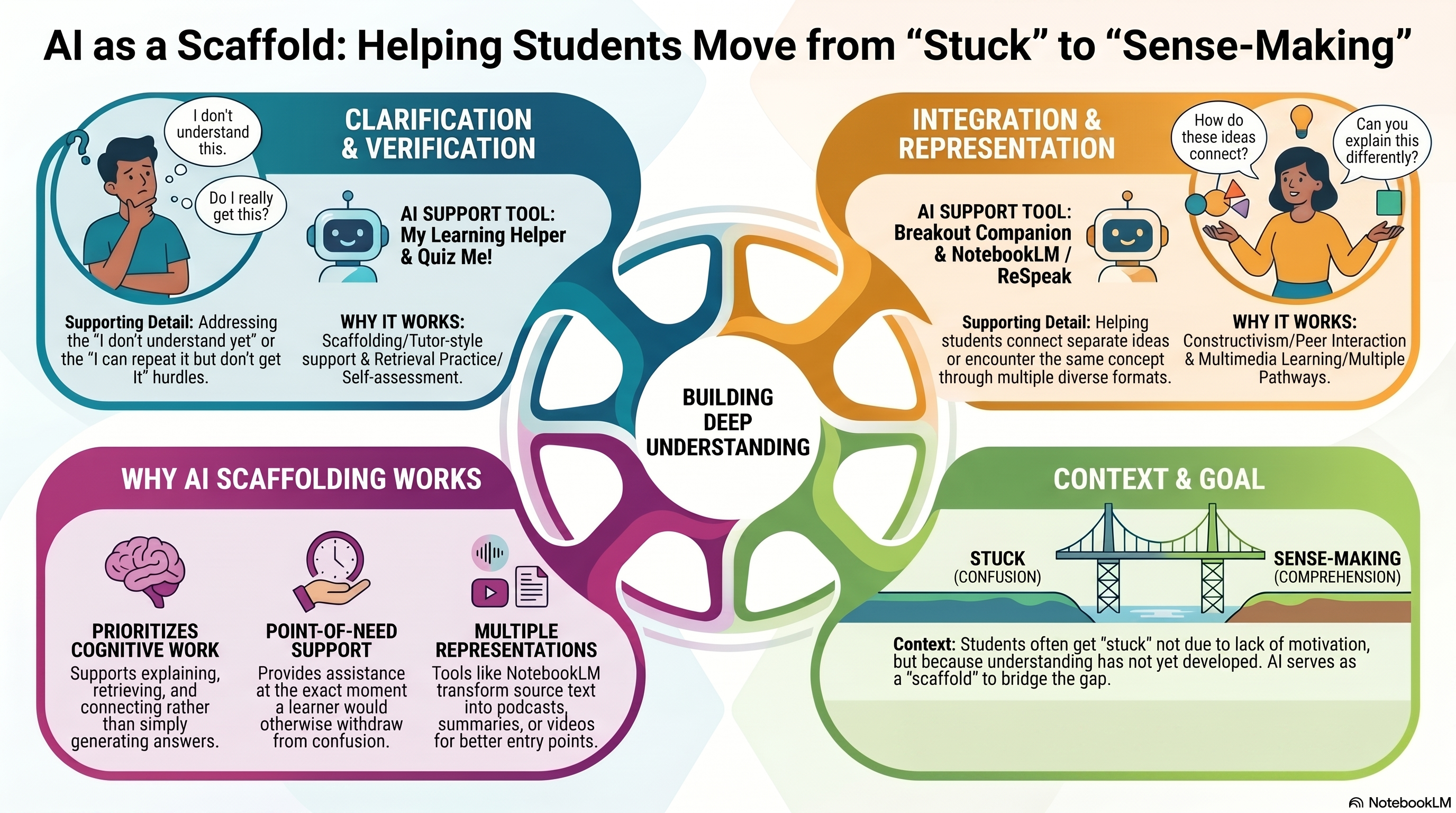
This is where AI can be useful—not as a shortcut to answers, but as a scaffold for sense-making. The key is to match the AI-supported activity to the specific barrier the learner is facing.
“I Don’t Understand This Yet”
The first challenge is the most familiar. A student encounters a new concept, theory, process, or framework and simply does not understand it yet.
One example of a tool designed to support this challenge is My Learning Helper, a custom GPT that provides tutor-style support for developing understanding. Students can ask clarifying questions, request examples, explore alternative explanations, or connect a new idea to something they already know.
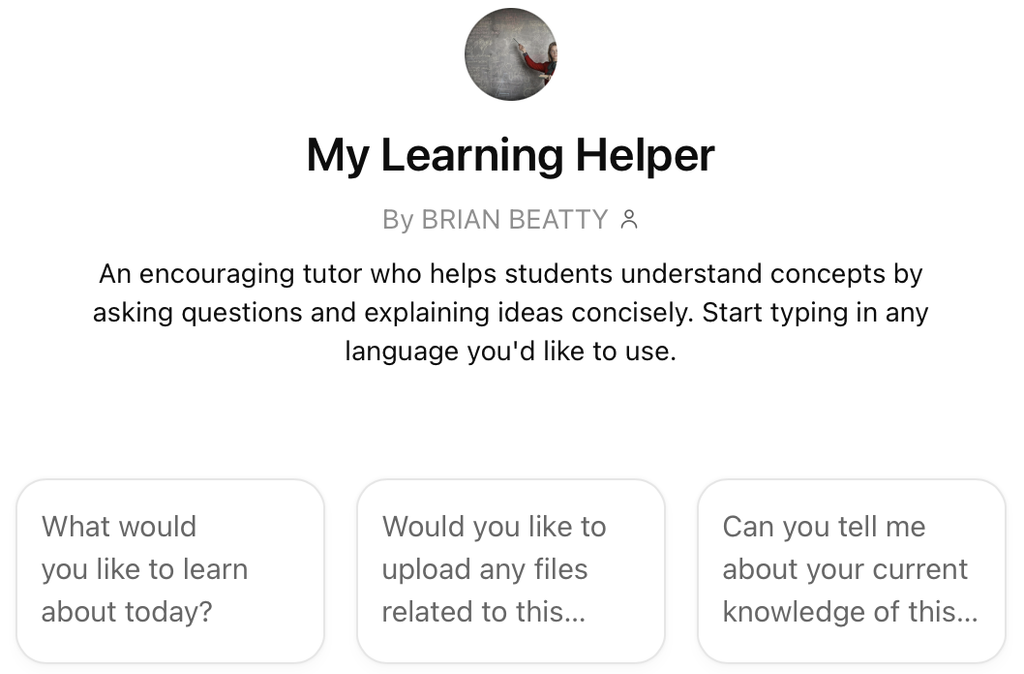
Link to the custom GPT in ChatGPT (ChatGPT account required; either free or paid):
https://chatgpt.com/g/g-67e363de658c8191b81a6cde90729d25-my-learning-helper
The goal is not for the tool to complete the work. The goal is to help the learner build enough understanding to keep going.
This use of AI fits well with the idea of scaffolding. Support is provided at the point where the learner cannot yet move forward independently, but still needs to remain engaged in the thinking process. In Vygotsky’s terms, AI can help learners work within the zone of proximal development when it provides support that extends their current capability without replacing their effort (Vygotsky, 1978; Wood, Bruner, & Ross, 1976).
“I Can Repeat It, But I Don’t Really Understand It”
A second challenge is more subtle. Students may recognize an idea, repeat a definition, or feel familiar with a concept after reading or watching a video. But familiarity is not the same as understanding.
One example of a tool designed to support this challenge is Quiz Me!, a custom GPT that provides a self-assessment environment where learners can check their understanding and identify gaps. The value here is not grading. It is helping students discover what they know, what they partially understand, and what still needs attention.
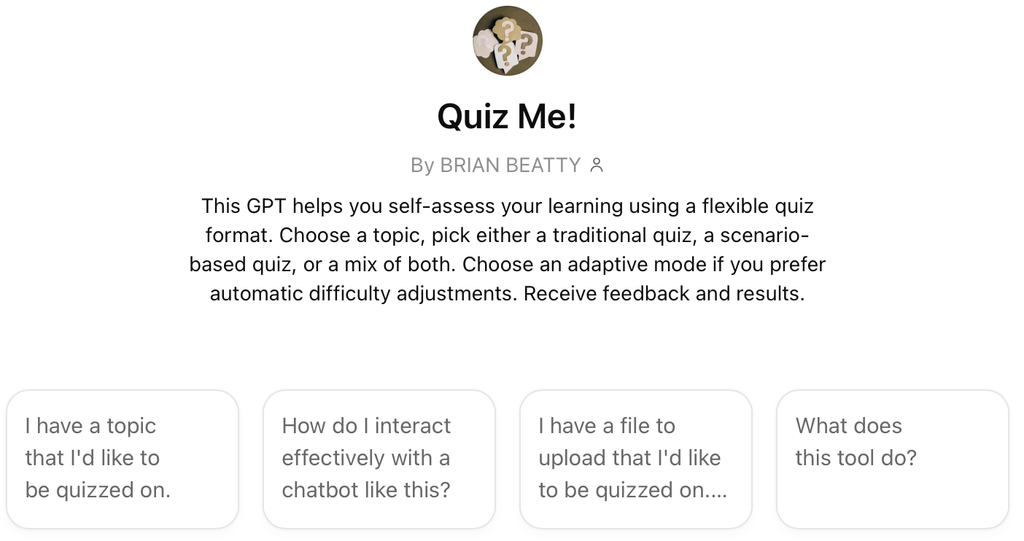
Link to the custom GPT in ChatGPT (ChatGPT account required; either free or paid):
https://chatgpt.com/g/g-67e34f20410481919f23c5da8a5c844e-quiz-me
This matters because students often overestimate their understanding when they only reread or review materials passively. Asking students to retrieve, explain, and apply ideas gives them a more accurate picture of their learning. Retrieval practice can strengthen learning, and self-assessment can support students’ ability to monitor and regulate their own progress (Karpicke & Blunt, 2011; Zimmerman, 2002).
“I Understand the Pieces, But I Can’t Connect Them”
A third challenge often appears in more advanced learning. Students may understand individual readings, examples, or concepts but struggle to see relationships among them.
This is where discussion matters.
One example of a tool designed to support this challenge is Breakout Companion, a custom GPT that supports structured peer interaction as a way of refining understanding. Rather than telling students what the ideas mean, the tool can help frame discussion, prompt comparison, surface assumptions, and encourage learners to articulate their own interpretations.
Link to the custom GPT in ChatGPT (ChatGPT account required; either free or paid):
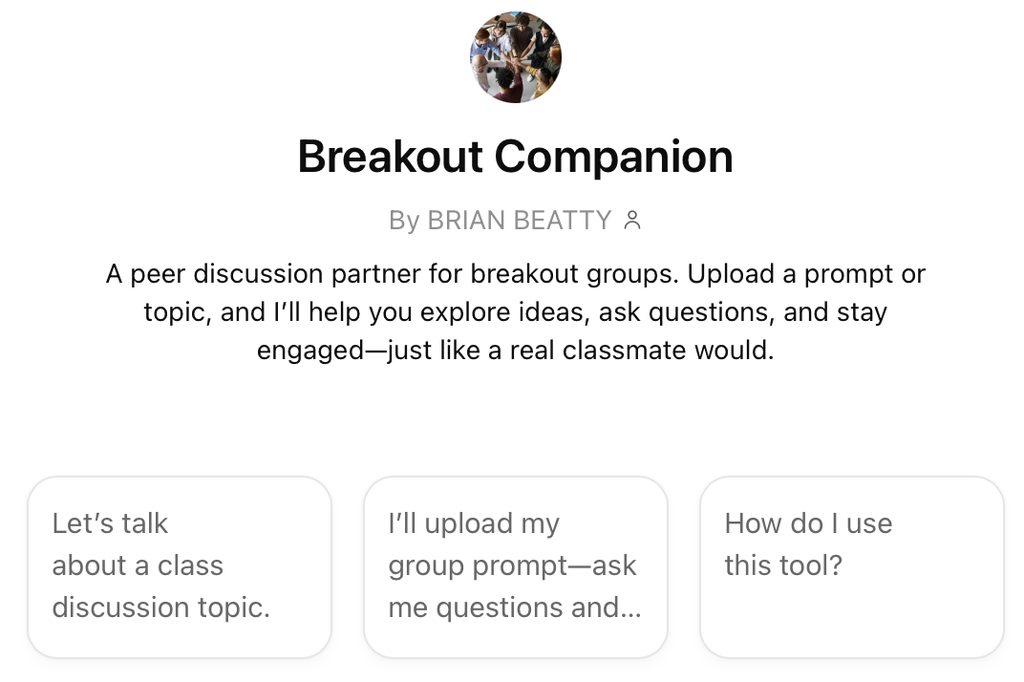
Link to the custom GPT in ChatGPT (ChatGPT account required; either free or paid):
https://chatgpt.com/g/g-67e36ff274008191942d19ffe8353758-breakout-companion
This kind of AI support is valuable because understanding is often constructed through dialogue. When learners explain their thinking to others, respond to alternative perspectives, and negotiate meaning, they deepen and refine their understanding. This aligns with constructivist views of learning that emphasize active meaning-making rather than passive reception of information (Duffy & Cunningham, 1996).
“I Need a Different Way to Encounter the Idea”
A fourth challenge cuts across the others. Sometimes learners do not need more information. They need a different representation of information they already have.
This is where tools such as NotebookLM and ReSpeak can be especially helpful.
NotebookLM provides one way to help learners encounter the same source material through multiple representations. A reading or set of documents can become a summary, a conversational podcast, or an explainer-style video. For this post, I have created an example podcast and explainer video about AIMON itself to show how the same concept can be represented in different ways for learners who are still building basic understanding.
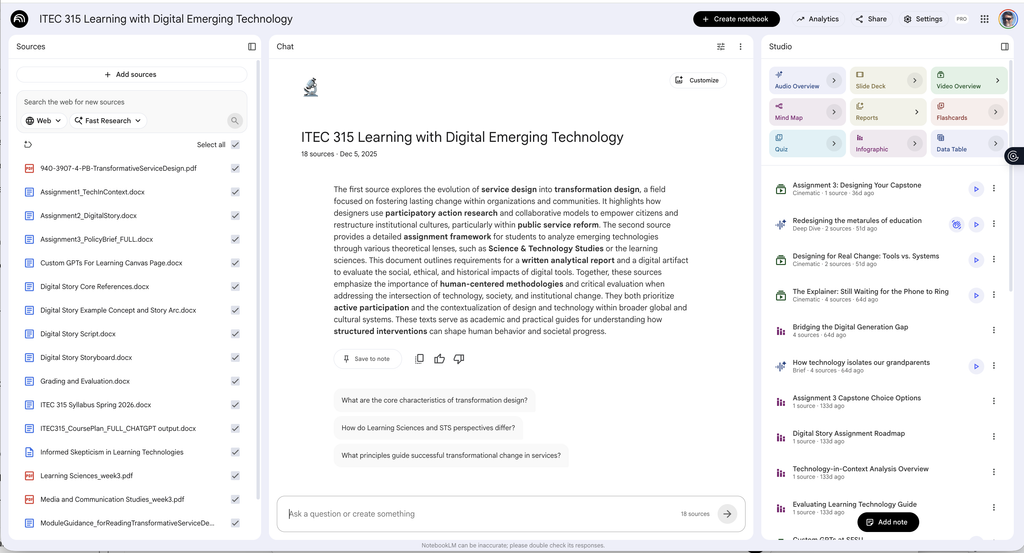
NotebookLM podcast example (short, 20 min debate-style explanation of the main ideas in this blog post): Listen to the “debate” podcast here.
NotebookLM short (1:30 min) audio overview explanation of one of the main ideas in this post: Listen to the “overview” podcast here.
NotebookLM explainer video: Watch the 4 minute video here.
For shorter passages of text, ReSpeak offers another form of support. A dense paragraph can be re-expressed as a simpler explanation, a practical example, an analogy, or even in story mode. These alternative forms of expression can help learners find an entry point into an idea that initially feels abstract or inaccessible.
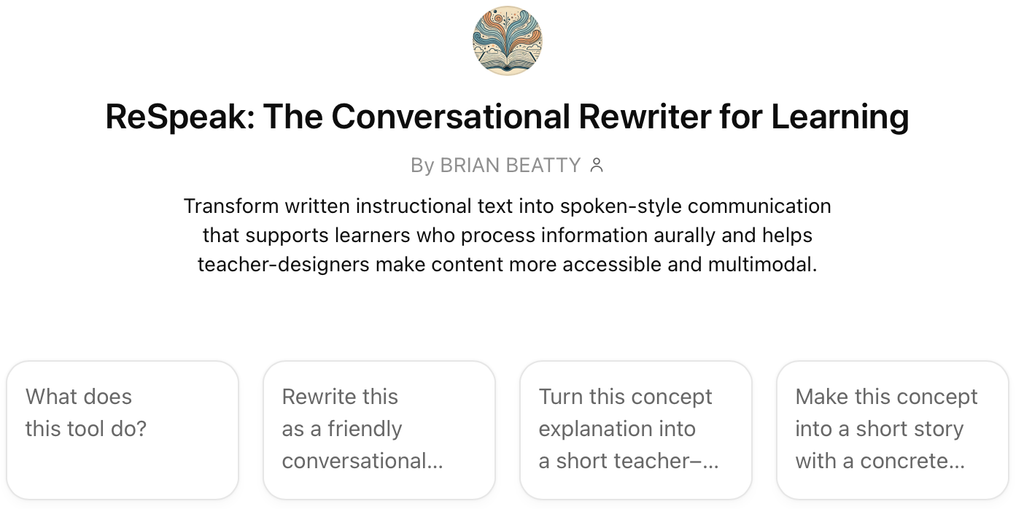
Link to the custom GPT in ChatGPT (ChatGPT account required; either free or paid):
For a sample of a student interaction in ReSpeak, view this transcript as a PDF file.
Or review the ChatGPT interaction directly: https://chatgpt.com/share/6a21d670-8760-83ea-bdbf-ca04dd840141 (requires a ChatGPT account)
This connects well with Mayer’s Cognitive Theory of Multimedia Learning, which emphasizes that learning can be supported when words and images—or other complementary representations—are designed to support meaningful processing rather than simply add more information (Mayer, 2009). From an AIMON perspective, the important point is not that one representation is always better than another. The point is that different representations can provide different pathways into understanding.
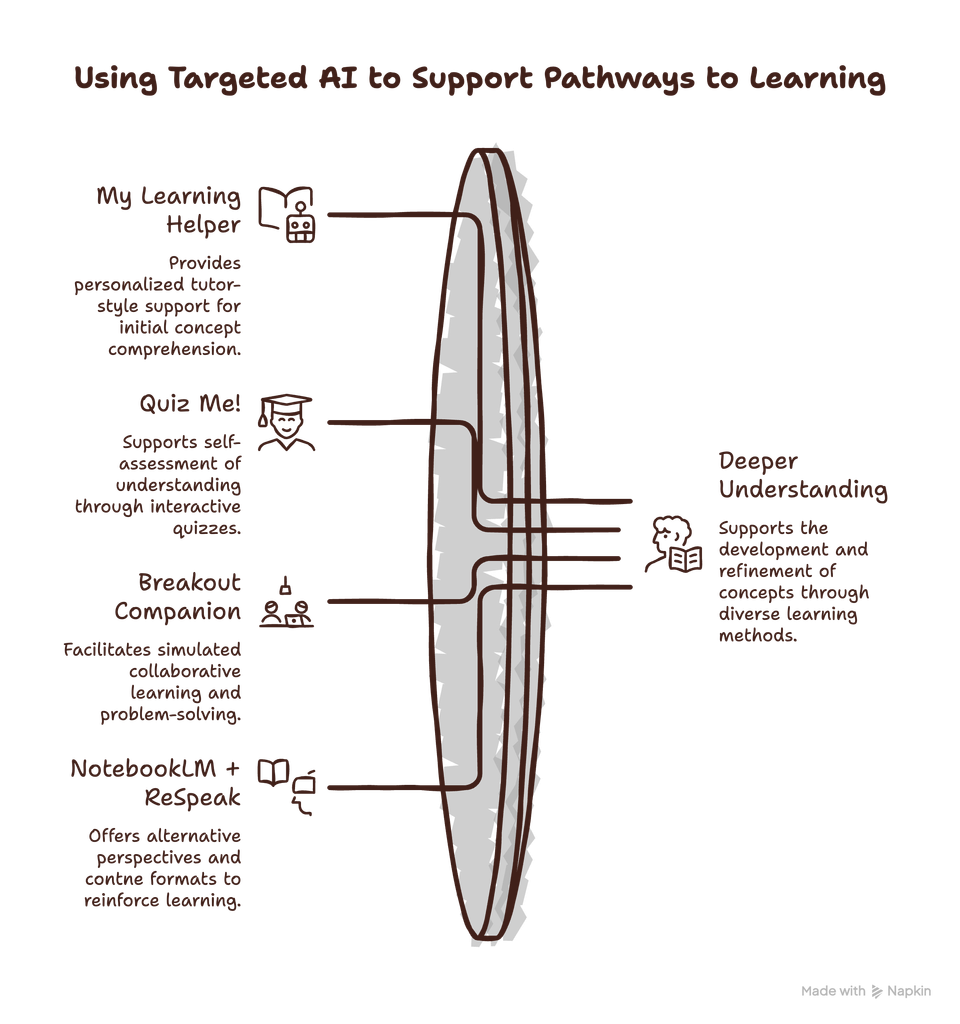
Why This Works
The moment in the learning process: This moment occurs after students have begun engaging with the course but before they have developed usable understanding. They are reading, listening, discussing, or practicing, but the ideas are not yet clear or connected. AI support is useful here when it helps students stay with the learning process rather than withdraw from confusion.
The type of cognitive work required: Building understanding requires more than receiving information. Learners need to explain, retrieve, question, connect, and represent ideas in ways that make sense to them. Different AI tools can support different forms of this cognitive work when they are designed as scaffolds rather than answer generators.
The form of support provided: My Learning Helper provides tutor-style explanation and guided questioning. Quiz Me! supports self-assessment and gap identification. Breakout Companion supports peer interaction and refinement of understanding. NotebookLM and ReSpeak provide alternative representations of ideas. In each case, the tool is useful because it supports overcoming a specific barrier to understanding.
None of these tools exist to replace learning; they just cannot do that. They exist to support learning when understanding has not yet developed. This is how we can use AI to enable and facilitate student learning when a gap in understanding is holding a student back.
Try This in Your Course
Think about a concept, reading, theory, or process that students often struggle to understand.
Which challenge appears most often?
Do students not understand the idea at all? Can they repeat it but not use it? Do they understand the pieces but not the connections? Or do they need a different representation before the idea becomes accessible?
Once you identify the challenge, consider what kind of AI-supported scaffold might help students move forward without removing the intellectual work of learning.
Looking Ahead to the Next Moment of Learning Need
Understanding alone is not enough. Learners eventually reach a point where they must apply what they know in authentic situations. In the next post, we’ll explore how AI can support students as they move from understanding concepts to using them.
References
Duffy, T. M., & Cunningham, D. J. (1996). Constructivism: Implications for the design and delivery of instruction. In D. H. Jonassen (Ed.), Handbook of research for educational communications and technology (pp. 170–198). Macmillan.
Karpicke, J. D., & Blunt, J. R. (2011). Retrieval practice produces meaningful learning. Science, 331(6018), 772–775. https://doi.org/10.1126/science.1199327
Mayer, R. E. (2009). Multimedia learning (2nd ed.). Cambridge University Press.
Vygotsky, L. S. (1978). Mind in society: The development of higher psychological processes. Harvard University Press.
Wood, D., Bruner, J. S., & Ross, G. (1976). The role of tutoring in problem solving. Journal of Child Psychology and Psychiatry, 17(2), 89–100. https://doi.org/10.1111/j.1469-7610.1976.tb00381.x
Zimmerman, B. J. (2002). Becoming a self-regulated learner: An overview. Theory Into Practice, 41(2), 64–70. https://doi.org/10.1207/s15430421tip4102_2
[…] Scaffold the process of making meaning. View blog post. […]
[…] Scaffold the process of making meaning. View blog post. […]