
When Understanding Is Not Enough
In the previous post, I focused on helping students build understanding. That is an essential moment in learning, but it is not the end of the learning process. Students may understand an idea well enough to explain it and still struggle when asked to use it in a real situation.
This is where many learners encounter a new kind of difficulty. They are no longer asking only, “What does this concept mean?” They are asking, “How do I use this idea to analyze something real, make a decision, tell a meaningful story, or propose a thoughtful response?” That shift from understanding to doing is often where learning becomes more demanding—and more valuable.
One of the courses where I have been developing and refining AIMON most extensively is ITEC 315: Learning with Emerging Technologies. The course fulfills an upper-division General Education social science requirement at San Francisco State University and attracts students from a wide range of majors across the university. For students in ITEC 315, this moment is especially important because many are not social science majors. They are learning about emerging technologies, but they are also learning how to think with social science concepts, evidence, context, stakeholders, and consequences. AIMON support at this stage is not about giving students the answer. It is about helping them practice the moves of application.
And though ITEC 315 is a fully online asynchronous course most times it is offered, this challenge can be especially visible in HyFlex courses, where students may be applying ideas from different participation modes, at different times, and with different levels of immediate access to peers and instructors.
The Context: ITEC 315, an undergraduate Social Science General Education course at San Francisco State University
Throughout the ITEC 315 course, students examine the relationships among emerging technologies, learning, work, culture, and society. They explore questions about equity, ethics, access, power, participation, and the ways technologies shape human experiences. While students certainly learn about technologies, the deeper goal is helping them think like social scientists, using concepts, evidence, and multiple perspectives to better understand complex issues and make informed judgments about possible futures.
In ITEC 315, many students are just beginning to understand ideas about emerging technologies, society, ethics, equity, and learning. The harder learning move for them is using those ideas in a social science way: analyzing a real context, interpreting evidence, making a grounded argument, or proposing a thoughtful response.
For many students, especially those outside social science majors, this kind of application is unfamiliar. They are not simply asking, “What does this concept mean?” They are asking, “How do I use this idea to analyze something real?”
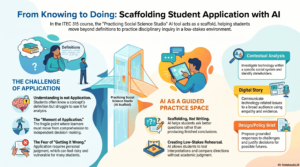
Common Student Experiences That Reveal a Need for Support
One of the reasons application is such an important moment in learning is that students often arrive at it with very different backgrounds, experiences, and levels of confidence. The challenge is not always a lack of understanding. Sometimes students understand the ideas but are unsure how to use them. Sometimes they are eager to learn but uncertain about what successful application looks like. The following composite examples illustrate two common patterns I see in ITEC 315 and in HyFlex learning environments more broadly. Although their situations are different, both students are encountering the same learning need: moving from understanding ideas to applying them in meaningful ways.
Mateo: Well-prepared but new to social sciences thinking and doing
Mateo is a junior majoring in communication studies. He is comfortable writing, discussing social issues, and connecting course readings to current technology debates. He quickly understands the broad goals of ITEC 315 and enjoys exploring emerging technologies that affect communication and social interaction.
As he begins the contextual analysis assignment, however, he discovers that strong opinions are not the same thing as strong analysis. He has no shortage of ideas, but he sometimes jumps too quickly to conclusions. The challenge for Mateo is slowing down enough to ask better questions, consider alternative perspectives, and support his claims with evidence rather than assumptions. His learning need is less about confidence and more about developing disciplinary habits of inquiry.
His challenge: “I understand the issue, but how do I apply course ideas in a disciplined way?”
Amina: Motivated but unsure
Amina is a transfer student majoring in kinesiology. She is motivated, curious, and genuinely interested in how technology affects people, but this is her first fully online upper-division GE course and she does not see herself as a strong academic writer. When she reads the course materials, she often understands the examples but is unsure how to translate that understanding into an assignment.
Her uncertainty grows when she compares her work to what she imagines other students might be producing. She worries about choosing the wrong topic, missing important ideas, or misunderstanding what the instructor is looking for. The challenge for Amina is not a lack of effort or intelligence. She needs support that helps her see how social science thinking works in practice and gives her confidence that she can participate successfully in that process.
Her challenge: “I want to learn, but I’m not sure how to turn these ideas into an assignment.”
Framing the Moment: Applying What Students Know
This is the moment when learners move from understanding ideas to using them.
In AIMON terms, this is a distinct learning need. Students may have enough understanding to begin, but not enough confidence or practice to apply ideas independently. They need support that helps them make decisions, test interpretations, and connect concepts to real situations.
The goal is not for AI to produce the work. The goal is to scaffold the process of doing the work.
What Learners Need When They Apply Ideas
At this stage, students often need help with two related challenges.
First, they may understand a concept but not know how to apply it to a real context. This is especially common when the discipline itself is unfamiliar. In ITEC 315, students are not only learning about emerging technologies; they are also learning how social science inquiry works.
Second, students may be afraid of getting it wrong. Application requires judgment. Students have to choose a focus, interpret a situation, connect evidence, and explain why their analysis matters. That can feel risky, especially for learners who are motivated but uncertain.
Example from Practice: ITEC 315 and the Practicing Social Science Studio
One example of a tool designed to support this moment is Practicing Social Science Studio, a custom GPT created to help students apply social science thinking across the three major ITEC 315 assignments.
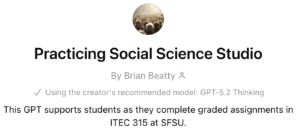
Try out the Practicing Social Science Studio GPT in the ChatGPT Store (requires a free or paid OpenAI account for ChatGPT access.) https://chatgpt.com/g/g-6a28841877288191ad49ab1ba581d04b-practicing-social-science-studio
The Three Major Assignments
The three major assignments in ITEC 315 provide students with opportunities to apply course concepts in increasingly sophisticated ways. Rather than simply demonstrating understanding of emerging technologies, students are asked to analyze real-world situations, communicate ideas to authentic audiences, and develop thoughtful responses to complex social issues. Each assignment requires students to practice social science inquiry while applying what they have learned to questions and challenges that matter beyond the classroom.
Contextual Analysis
In the first major assignment, students investigate an emerging technology within a specific social context. They identify stakeholders, explore benefits and concerns, examine relevant evidence, and analyze how the technology affects individuals, communities, or institutions. The goal is not simply to describe a technology, but to understand it as part of a larger social system.
Digital Story
In the second assignment, students create a short digital story that communicates a technology-related issue, experience, or perspective to a broader audience. This requires students to move beyond analysis and think about communication, empathy, and audience engagement. They must decide what story to tell, whose voices should be represented, and how evidence and personal experience can be woven together effectively.
Design Proposal or Policy Brief
In the final assignment, students propose a response to a technology-related challenge identified through their earlier work. Some students develop design proposals, while others create policy briefs. In both cases, students must apply what they have learned throughout the semester to recommend actions, justify decisions, consider stakeholders, and anticipate possible consequences.
Support from the Practicing Social Science Studio custom GPT
The Practicing Social Science Studio tool supports students as they work on contextual analysis, digital storytelling, and design proposal or policy brief work. It does not simply explain content. Instead, it helps students practice the kinds of thinking required in the course: identifying a social context, asking better questions, connecting course ideas to evidence, considering stakeholders, and developing more grounded interpretations.
For students like Mateo, the tool can help sharpen analysis. For students like Amina, it can make the process of applying ideas feel more approachable and less mysterious.
Sample ChatGPT Interaction – Practicing Social Science Studio [PDF file]
Read a sample interaction from a student (non-specific) using the Practicing Social Sciences Studio GPT for Assignment 1.
Challenge 1: “I Understand the Concept, But I Don’t Know How to Apply It”
This is the central application challenge.
A student may understand terms such as equity, access, surveillance, bias, automation, or digital divide. But when asked to analyze an emerging technology in a real setting, the student may not know where to begin.
AI support can help by asking guiding questions: What is the setting? Who is affected? What assumptions are built into the technology? What evidence would help you understand the issue? What course concept might help frame the analysis?
This kind of support helps students move from general understanding to disciplined application.
Challenge 2: “I’m Afraid of Getting It Wrong”
Application can feel more vulnerable than comprehension. Students are no longer simply reporting what someone else said; they are making choices and interpretations.
AI can help reduce this fear by creating a low-stakes space for rehearsal. Students can test an idea, compare possible directions, or ask whether their focus is too broad or too narrow. The tool can respond with questions and suggestions rather than judgment.
This is especially important for students who are motivated but unsure of how academic expectations work in a new field.
Why This Works
The moment in the learning process: Students have moved beyond initial understanding and are beginning to use ideas in authentic or semi-authentic tasks. This is a fragile moment because learners may understand enough to begin but not enough to proceed confidently. Well-designed support helps them continue doing the work instead of retreating to summary or avoidance. For HyFlex learners, that support can also help create more consistent access to guidance across participation modes.
The type of cognitive work required: Application requires judgment, transfer, and decision-making. Students must connect concepts to situations, interpret evidence, consider context, and justify choices. AI support is useful when it helps students practice those moves rather than providing finished conclusions.
The form of support provided: Practicing Social Science Studio works as a guided practice space. It helps students ask better questions, clarify their reasoning, and connect course concepts to real-world contexts. The support is valuable because it helps students do the intellectual work of application with greater confidence and structure.
Video Summary: (9:39 min)
Beyond Any One Course – or course mode
Although this example comes from ITEC 315, the challenge is common across fields.
Students in any course, including HyFlex courses where application may unfold across in-person, synchronous online, and asynchronous participation, may understand an idea in the abstract but struggle to apply it in context. This happens when students use theories to interpret cases, apply methods to real data, use ethical principles to evaluate decisions, or translate concepts into design choices.
In each case, AI support should not replace application. It should help learners practice application.
Try This in Your Course
Think about one assignment where students must apply ideas rather than simply explain them.
Where do they usually get stuck?
Do they struggle to choose a context, connect concepts to evidence, make a decision, or justify their reasoning?
Now consider how AI could provide a low-stakes practice space where students can test their thinking before producing final work.
Looking Ahead
Application often leads to another kind of learning need: problem-solving. Once students begin using ideas in real situations, things do not always go smoothly. In the next post, we’ll explore how AI can support learners when they encounter problems, uncertainty, or unexpected complexity.
[…] Scaffold the process of learning through doing. View blog post. […]
[…] Scaffold the process of learning through doing. View blog post. […]