
In every course I’ve taught, whether as a high school teacher, an undergraduate instructor, or working with graduate students, there is a predictable pattern in the first few days.
Some students get started right away. They understand what the course is about, what is expected of them, and how to begin. Others are less certain. They hesitate. They look for clarity. They may wait a few days before engaging, hoping things will become clearer.
At all levels, some (and often many) students need help figuring out what the course is really about and what is expected of them. In come classes, the first few classes address aspects of course design, student evaluation (grading) and other expectations. In other classes, faculty jump right into covering content and don’t spend much time explaining these important aspects of the student experience.
Consider two common situations.
Jordan is enrolled in a graduate-level HyFlex course. After attending the first session, everything seems clear. But later, while reviewing the course site alone, uncertainty creeps in. There are multiple participation options, layered expectations, and detailed grading criteria. Jordan begins to wonder what “full participation” really looks like across modes, and hesitates to ask. And even when he decides to ask a question, he feels he has to wait until the next class meeting, which could be five or six days away.
Maya, a college junior in her first fully asynchronous online course, encounters a different version of the same problem. She opens the first module and finds readings, discussions, and an assignment all at once and due within a few days. Without a live session to guide her, she is unsure where to begin. The expectations feel dense, and the path forward is not obvious.
In both cases, the issue is not motivation or ability. It is timing. These students need support at a very specific moment, and without it, even a short delay can lead to confusion, stress, and may lead to disengagement. This is a worst-case scenario that some students face at the beginning of every term.
Framing the Moment: Getting Started
This is what I think of as a “getting started” moment: the point at which students are trying to orient themselves to a new learning environment.
At this stage, learners are making sense of structure, expectations, and pathways for participation. They are trying to answer a set of basic but critical questions: What should I do first? What matters most? How do I know if I’m on track?
This moment is easy to underestimate because it does not always look like “deep learning.” But it is foundational. When students struggle here, everything that follows becomes more difficult. Some find the start so overwhelming they may choose to drop the class while they still can.
What Learners Need at the Start
The needs at this stage are both cognitive and affective. Students are processing a large amount of new information: course structure, policies, tools, expectations, while also trying to build confidence and momentum.
When that information is unclear or overwhelming, cognitive load increases. Students spend more time figuring out how the course works than engaging with the content. Research on transparent teaching shows that when instructors clearly communicate the purpose, tasks, and criteria for academic work, students experience greater confidence, belonging, and success (Winkelmes et al., 2016).
What helps most at this stage is not more information, but timely clarification, support that makes expectations visible and actionable for students (Winkelmes et al., 2016).
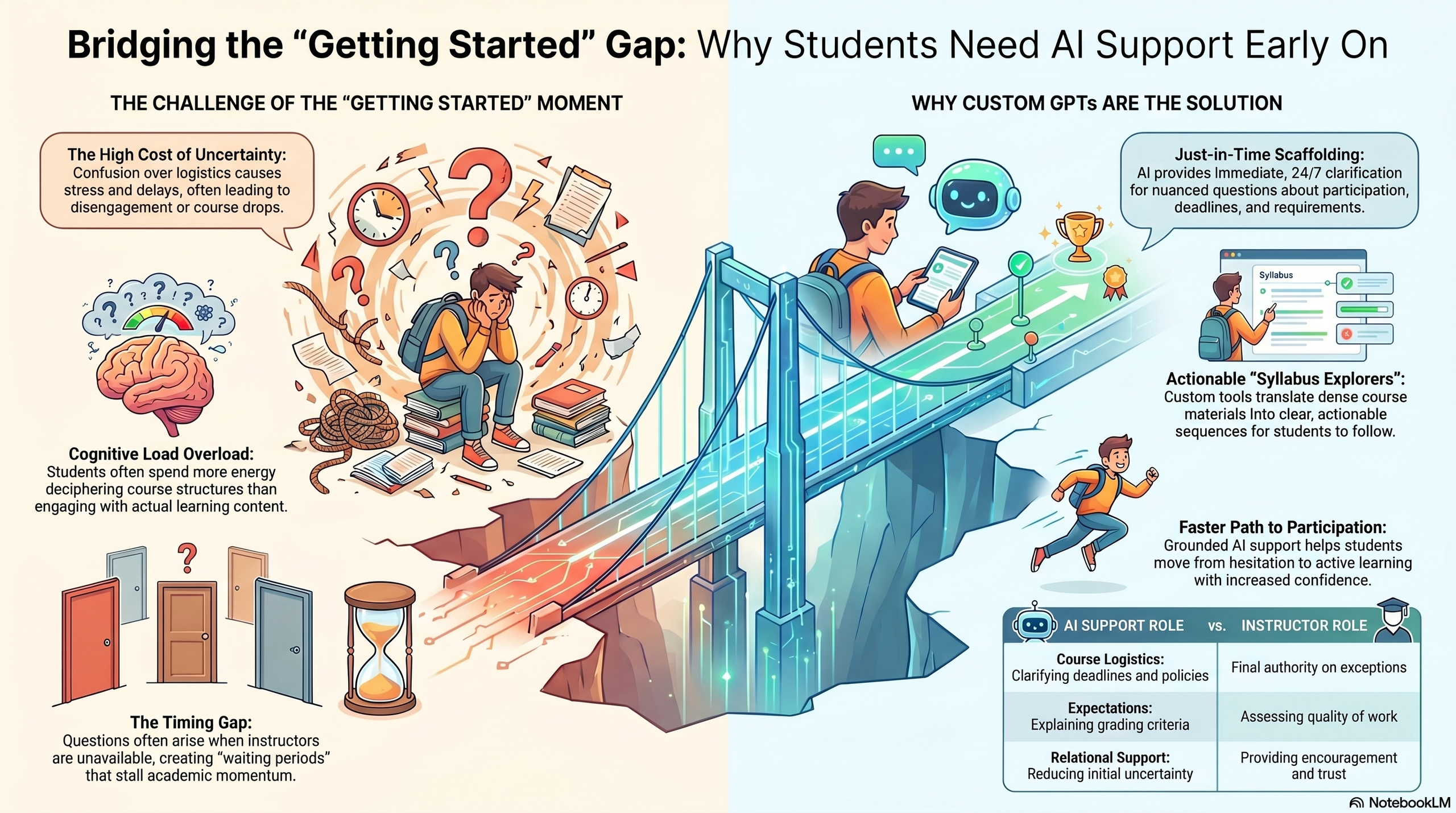
Where AI Fits (and Where It Doesn’t)
This is one of the moments where AI can be particularly useful, because the need is immediate, recurring, and not tied to disciplinary content.
Students often have questions that are simple in nature but difficult in timing. They arise when the instructor is not available, or when the student is unsure whether the question is worth asking. AI can provide a form of just-in-time scaffolding by offering immediate clarification and guidance.
Some of the questions students ask at this stage are surprisingly nuanced:
– “If I attend synchronously this week, do I still need to post in the discussion?”
– “What does a strong first post actually look like?”
– “How much time should I spend on this course each week?”
– “If I fall behind early, can I recover?”
– “What does ‘engaged participation’ really mean in this class?”
These are questions AI can often help answer, especially when grounded in course-specific materials.
But there are other questions that AI should not answer on its own:
– “Am I doing well so far?”
– “Should I be worried about my performance?”
– “What strategy should I use to succeed in this course?”
These require instructor judgment, encouragement, and relational support.
The distinction matters.
AI can reduce uncertainty and clarify expectations, but it should not replace instructor presence or the human aspects of teaching that build trust and motivation.
Beatty, 2026
Example from Practice
In my own courses, I’ve experimented with providing AI-based support for this moment through several custom GPTs designed to help students explore the syllabus and course structure. One of these GPTs, “Syllabus Explorer” is available to students in all of my classes and is linked in the LMS from several places in the “Getting Started” and first few course modules. (You can try this GPT in your own ChatGPT account using this link: https://chatgpt.com/g/g-67e37a70e7dc8191b31366840ddd4694-course-syllabus-explorer)
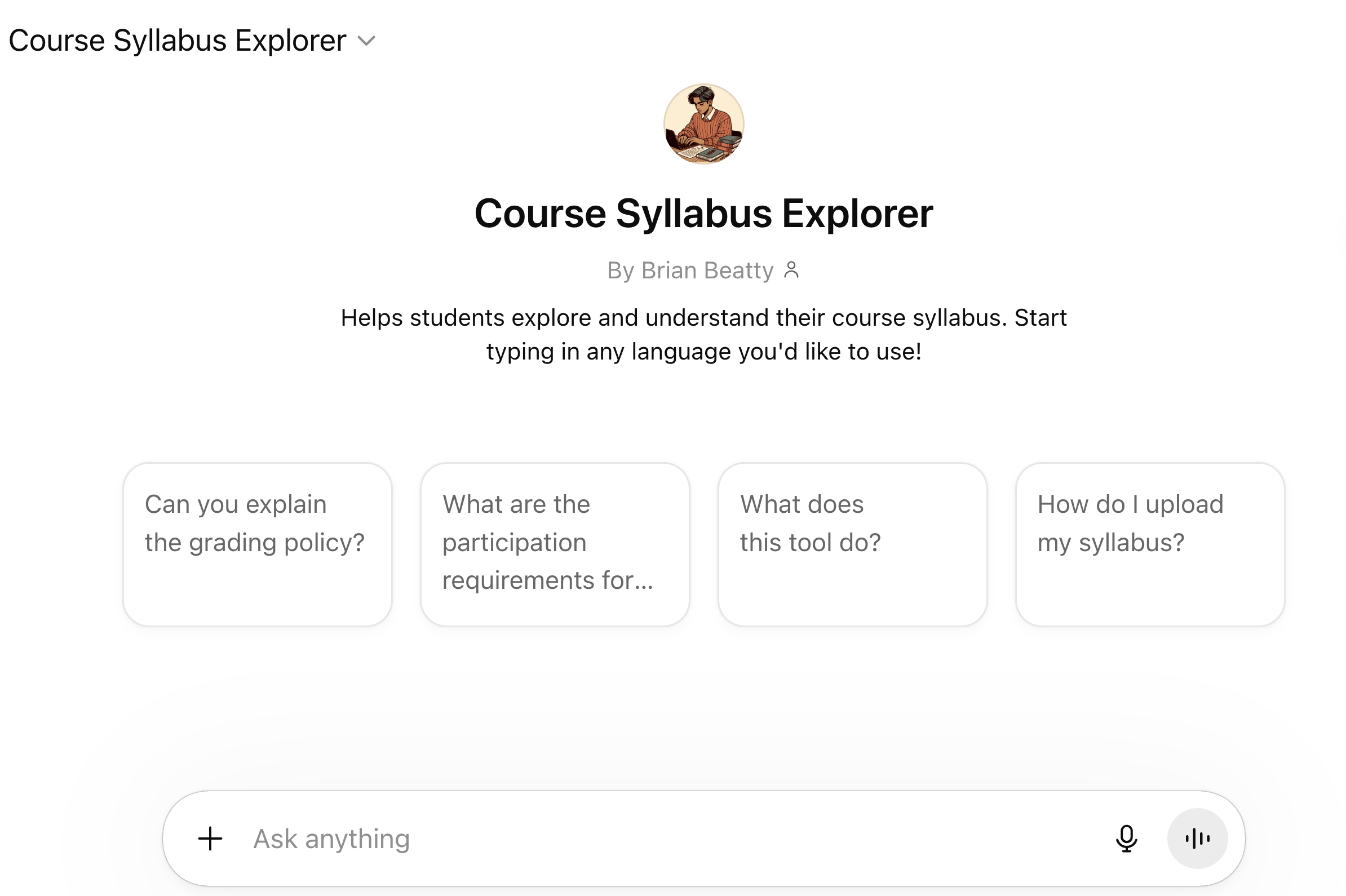
Students can ask questions about deadlines, participation, or assignment expectations and receive immediate responses grounded in course materials. The result is not that students stop engaging with the syllabus, but that they are better able to interpret and act on it.
What I’ve observed is a shift in timing. Instead of waiting, hesitating, or guessing, students are more likely to move forward. They begin participating earlier and with more confidence.
This kind of support is also broadly applicable. Because the need is not content-specific, tools designed for this purpose can be useful across disciplines, course formats, and levels.
If you’d like to review the GPT for yourself, with a ChatGPT account you can search for this in the OpenAI GPT Store. For more explanation of this and other custom GPTs I created and use in all classes, see “Using GPTs to Engage “Accidental” Asynchronous Learners” (Beatty, 2024). Other custom GPTs that work well in “Getting Started” moments like these are “HyFlex Mode Chooser” and “Study Planner”.
Note: Reference links to custom GPTs in these blog posts may change due to the constantly changing nature of this work. You can always find custom GPTs that I build in the OpenAI GPT “store” using your own chatgpt.com account -search for the GPT by name or by author’s name (Brian Beatty).
Why This Works
The effectiveness of this approach comes from aligning support with the moment of need.
The moment in the learning process: Early in the course, students are trying to reduce uncertainty and establish direction. Providing support at this point helps them get oriented before confusion compounds and delays engagement.The type of cognitive work required: At this stage, students are not yet engaging in deep disciplinary thinking. They are interpreting structure and expectations. Supporting that sense-making allows them to focus their cognitive effort where it matters most later.
The form of support provided: AI can act as a scaffold by offering timely clarification and guidance. This reduces unnecessary cognitive load while still requiring students to engage with course expectations and take responsibility for their learning.
When these elements align, students move from hesitation to action more quickly.
We can see this in how Jordan and Maya’s experiences may shift with this type of AI support.
Jordan uses the AI support tool to clarify participation expectations and assignment timing. Within minutes, the structure of the course becomes clear again, and planning replaces uncertainty.
Maya asks where to begin and receives a simple, actionable sequence. What initially felt overwhelming becomes manageable. She starts her work the same day instead of delaying.
In both cases, the work itself has not changed. What has changed is the clarity around how to begin.
Beyond Any One Course
Although these examples come from specific contexts, the underlying need is nearly universal.
Any learning environment that requires students to navigate structure, interpret expectations, and begin engaging independently will benefit from well-designed support at this stage. Whether in a HyFlex course, a fully asynchronous environment, or a traditional classroom, helping students get started effectively can shape their entire learning trajectory.
Try This in Your Course
Think about the first week of your course.
Where do students hesitate? What do they misunderstand? What questions do you find yourself answering again and again?
Now consider how you might provide immediate, low-stakes support that helps students move forward, without removing their responsibility to engage with the course. An appropriate AI tool might be a workable solution for many.
Looking Ahead
In the next post, we’ll move further along the learning arc to examine how faculty can provide AI support to students as they work to build understanding of new and often complex ideas.
References
Beatty, B. (2024). Using GPTs to Engage “Accidental” Asynchronous Learners. In C. Bonk & G. Marks (Eds.), Proceedings of E-Learn: World Conference on E-Learning in Corporate, Government, Healthcare, and Higher Education (pp. 150-157). Singapore, Singapore: Association for the Advancement of Computing in Education (AACE). Retrieved April 27, 2026. from https://www.learntechlib.org/primary/p/224994/.
Winkelmes, M.-A., Bernacki, M., Butler, J., Zochowski, M., Golanics, J., & Weavil, K. H. (2016). A teaching intervention that increases underserved college students’ success. Peer Review: Emerging Trends and Key Debates in Undergraduate Education, 18(1/2), 31.
[…] the previous post on using GenAI to help students who are just getting started on their learning journey, I focused […]
[…] Help learners find a path forward on the learning arc. View blog post. […]
[…] Help learners find a path forward on the learning arc. View blog post. […]
[…] Help learners find a path forward on the learning arc. View blog post. […]
[…] Help learners find a path forward on the learning arc. View blog post. […]
[…] Help learners find a path forward on the learning arc. View blog post. […]