For decades, educators have primarily evaluated the quality of the final product. We assess essays, projects, exams, presentations, portfolios, and discussions by asking, “How well did the student perform?”
Performance remains important and should remain important. Academic quality, accuracy, sophistication, and achievement of learning objectives are central responsibilities of teaching and assessment. However, contemporary learning environments increasingly present educators with a second challenge: we often see the finished product while seeing very little of the learning process that produced it. We now wonder how much of the work was completed by the learner.
The Index of Authentic Learning (IAL) was developed to address that challenge. It helps educators distinguish between the quality of a submitted product and the visibility of the learning process behind that product.
• IAL is not an AI detector.
• IAL is not plagiarism software.
• IAL is not an authorship verification system.
• IAL is a framework for evaluating the visibility of learning.
Rather than asking, “Did the student use AI?”, IAL asks, “How visible is the student’s learning process from the evidence provided?”
The central concern of IAL is not authorship. It is observability. IAL acts as a visibility coach.
The Traceability Principle
IAL introduces the concept of traceability. It aligns with the goal of IAL: determining whether the evaluator can trace the path from early thinking to final product. In IAL, learning becomes visible when the evidence allows another educator to trace the student’s decisions, revisions, uncertainties, use of evidence, and changes in thinking. A final answer alone may demonstrate performance, but it does not necessarily make the learning process traceable.
Before assigning visibility credit, IAL asks whether a claimed learning event can be traced from evidence in the submission:
1. What specifically happened?
2. What evidence influenced it?
3. What changed?
4. Why did it change?
5. Could another educator reasonably reconstruct the event from the submitted evidence?
If these questions cannot be answered from the submission, visibility remains limited regardless of assignment completion, effort, or product quality.
Why Learning Visibility Matters
Two students may submit work of similar quality while revealing very different amounts of learning evidence. One student may document decisions, revisions, uncertainties, source evaluations, and changes in thinking. Another student may submit equally strong work while revealing almost nothing about how conclusions were reached. Both students may earn the same academic grade. Their learning visibility may be dramatically different.
IAL was developed to help educators examine that distinction without turning visibility into an accusation. Low visibility is not a finding of misconduct. It is a description of what the submitted evidence allows an evaluator to see.
Three Separate Questions
IAL encourages educators to keep three questions separate:
1. How well did the student perform? (P)
Performance refers to the quality of the academic product. Performance is determined by the instructor using the course grading criteria. IAL does not calculate performance; it uses the instructor-provided performance score as contextual information alongside visibility results.
• Is the work accurate?
• Is it complete?
• Does it demonstrate disciplinary competence?
• Does it meet assignment expectations?
2. How much learning evidence became visible? (L)
Learning Evidence measures how observable and traceable the student’s learning process is from the submitted evidence. IAL evaluates only visible evidence. It does not infer unobserved thinking, effort, research, revision, struggle, or decision-making. Learning Evidence consists of two related dimensions:
L1 – Process Breadth
L1 asks how many categories of learning activity become visible. Categories may include choice justification, assumption revision, uncertainty navigation, source evaluation, planning, revision, error correction, and reflection.
Important calibration rule: the presence of a process category does not automatically create visibility. Generic process references such as “I researched,” “I revised,” or “I used online sources” should not raise L1 above a minimal level unless the submission includes a specific example of what occurred.
L2 – Process Depth / Traceability
The concept of reconstructability is useful as a test. It asks whether another educator can reasonably reconstruct what happened from the submitted evidence? L2 also asks how well another educator can trace or reconstruct the student’s reasoning. Strong L2 evidence shows what changed, why it changed, what evidence influenced the change, and how the student moved from one decision to another.
Together, L1 and L2 produce Learning Evidence (L). L1 captures the range of visible process categories, while L2 captures the depth and traceability of the evidence.
3. How confidently can we interpret visibility? (V)
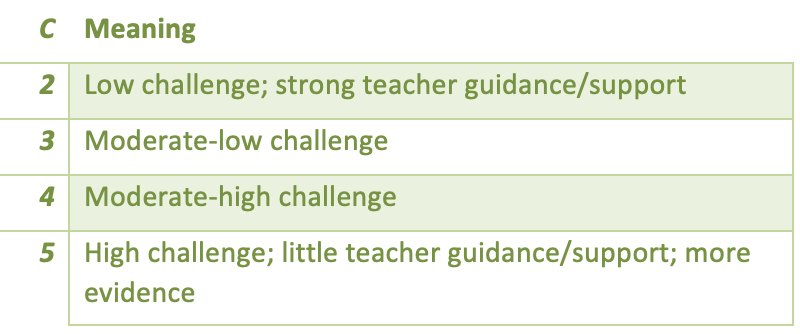
Visibility does not exist in isolation. Assignment design matters. Students cannot reasonably reveal learning processes that were never clearly requested. IAL therefore evaluates assignment transparency through C, or Visibility Challenge.
• Were process expectations explicit?
• Were examples provided?
• Were revision expectations defined?
• Were students told what visible reasoning looks like?
IAL calculates: V = L / C
Learning Visibility is equal to Learning Evidence divided by assignment Visibility Challenge. Stated another way, C measures the visibility challenge created by the assignment design. C is a property of the assessment design.
V compares the visible learning evidence to the visibility opportunity created by the assignment challenge. It should be interpreted as a calibrated visibility score, not as an academic grade and not as a confidence score about authorship.
The same amount of observed evidence carries different interpretive weight depending on the assignment context. For example, assignment A is highly scaffolded (L=4, C=2) since the instructor requires:
• Reflection
• Draft submissions
• Revision notes
• Source annotations
This assignment is designed to promote learning visibility.
Assignment B is just the single product submission (L still = 4, C=5) since the instructor only requires:
• The final product
• No drafts
• No reflections
• No process checkpoints
Assignment B provides few to no opportunities for learning to become visible.
Note that the meaning of L cannot be interpreted independently of C. C prevents us from judging learning visibility without first considering whether the assignment gave students a reasonable opportunity to make their learning visible.
Although I refer to V as a confidence measure, it is actually observed learning evidence adjusted for assignment context (context-adjusted visibility). Confidence is more correctly a consequence. A higher V indicates that more learning evidence became visible relative to the visibility challenge posed by the assignment. We adjust our interpretation of the evidence based on the assignment conditions.
Observable Process Versus Reported Process
A core principle of IAL is that reported process is not the same as observable process. Reported process tells the evaluator that something may have happened. Observable process shows enough evidence for the evaluator to trace what happened.
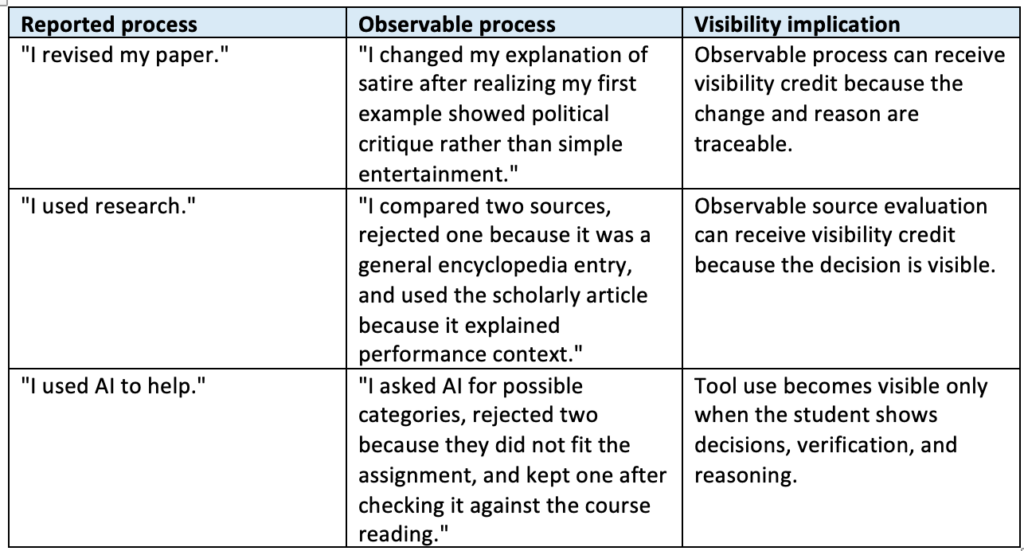
Generic statements may be true, but IAL does not award substantial visibility credit for truth claims alone. Visibility is earned through evidence that makes the learning process traceable.
The Visibility Archetypes in IAL
IAL uses three visibility archetypes. These archetypes describe the visibility of learning evidence, not the quality of the final product and not the honesty of the student (work originality).
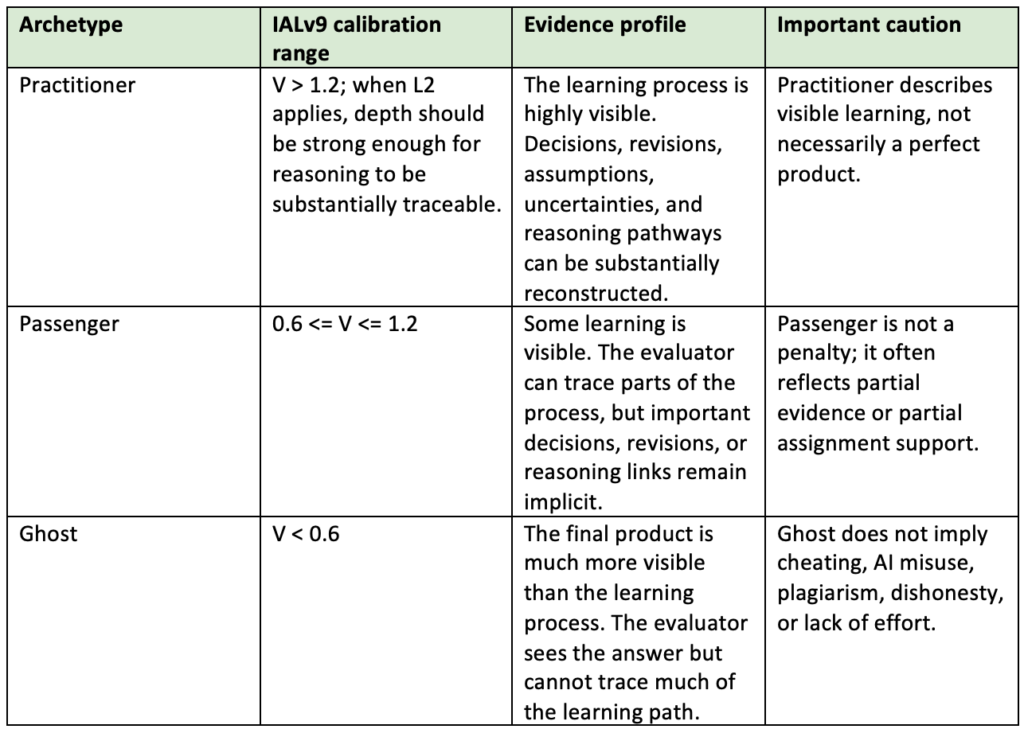
These ranges should be applied alongside the IAL evidence rules: generic process references remain low-visibility unless supported by specific examples, and high product quality should not substitute for visible process evidence.
Why High-Performing Work May Still Be Ghost
A student can produce excellent work and still receive a Ghost classification because performance and visibility answer different questions. Performance asks whether the product is strong. Visibility asks whether the learning process behind the product became observable.
High-performing Ghost work often has polished explanations, accurate content, strong organization, and sophisticated language. What it lacks is trace evidence: drafts, decision points, false starts, source judgments, revision rationales, uncertainty, or explanation of how the student moved from initial thinking to final answer.
This distinction is especially important in the age of AI, but it is not limited to AI. A student may produce a Ghost submission because the assignment did not ask for process evidence, because the student did the work privately, because the final product was copied from notes without drafts, or because the student simply did not know that process visibility mattered.
Therefore, Ghost should be treated as an instructional signal, not a disciplinary conclusion. It tells the instructor that the final product may be gradeable, but the learning process is largely hidden.
Why Performance and Visibility Are Separate
One of the most useful features of IAL is the comparison between performance and visibility. Remember, P represents the instructor assigned grade. V represents how confidently we can interpret visibility. A student may demonstrate:
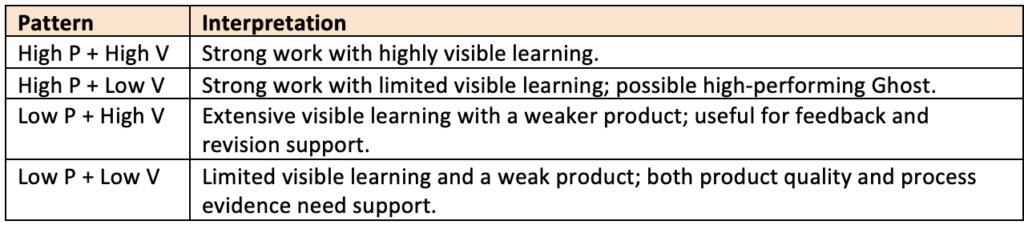
These patterns provide instructional insight that traditional grading alone cannot provide. IAL therefore complements instructor evaluation rather than replacing it.
What IAL Is
IAL is:
• a visible learning framework
• an assignment design framework
• a faculty development tool
• a process visibility framework
IAL is not:
• an AI detector
• plagiarism software
• authorship verification
• a grading replacement system
IAL evaluates the visibility of learning. It does not evaluate the origin of the work. Where traditional assessment asks, “What did the student produce?”, IAL asks, “How much opportunity did this assignment provide for the learning to become observable?”. Ultimately, the central question remains:
How much of the student’s learning process became observable and traceable from the evidence provided?