
Challenged by Change When Learning
In the previous post about helping students work through problems during their learning experience, I explored how AI can support learners when they encounter problems, uncertainty, and unexpected challenges. Those moments often arise when something does not work as expected, and students must diagnose, interpret, and work through difficulty.
But not every learning challenge begins with a problem.
Sometimes the challenge is change itself.
Unlike the challenges discussed in the previous post, adaptation does not necessarily begin with a problem. Often the learner is making progress, but new perspectives, capabilities, or contexts require reconsideration of what was previously understood or how it should be applied.
As students move through a course, they encounter new perspectives, new tools, new information, new audiences, and new contexts for applying what they know. The challenge is not simply recognizing that something has changed. The challenge is deciding whether the change matters and, if it does, determining how to respond.
This is the learning moment explored in this post.
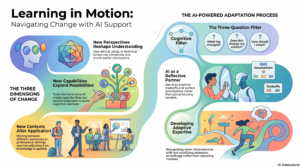
In the traditional Five Moments of Need framework, this moment is often described as “Change” (Gottfredson & Mosher, 2011). In educational settings, however, adaptation is rarely a single event. Learners often move through a sequence of questions:
What has changed? | Does this change what I should do? | How should I adapt?
Not every change requires action. Some new information confirms what students already understand. Some new tools add little value to an existing process. Some contextual differences are not significant enough to justify changing an approach. The challenge is not reacting to every change. The challenge is understanding which changes matter and adapting thoughtfully.
[Insert overview infographic image]
Learning Does Not Stand Still
One of the reasons adaptation is so important is that learning rarely occurs in a stable environment.
Students are constantly encountering new ideas, technologies, expectations, and situations. Sometimes those changes alter their understanding. Sometimes they expand what is possible. Sometimes they require them to apply knowledge in unfamiliar ways.
In my experience, three forms of change appear frequently in higher education:
- New perspectives change earlier understanding.
- New capabilities change what is possible.
- New contexts change what application requires.
Each creates opportunities for learning, but each also requires learners to make judgments about what should remain stable and what should change.
Change Type 1: New Perspectives Change Earlier Understanding
One common form of change occurs when students encounter new perspectives that reshape how they understand earlier ideas.
This happens frequently in courses that intentionally build understanding over time. Students learn one set of concepts, begin applying them, and then encounter additional perspectives that complicate or enrich their earlier thinking.
For example, in ITEC 315, students explore emerging technologies and their effects on learning, work, and society. Early in the semester, a student may evaluate a technology primarily in terms of usefulness, convenience, or access. Later, the course introduces additional perspectives related to equity, ethics, participation, and social impact. Those new perspectives often lead students to revisit earlier conclusions.
A similar process occurs in ITEC 830. Students may initially explore an emerging technology as a tool for accessing content or supporting exploration. Later in the course, they are challenged to examine that same technology through the lenses of learner engagement, assessment, feedback, or instructional design. The technology has not changed, but the perspective has.
This is not a failure of understanding. It is evidence that understanding is developing.
AI can be particularly useful in this moment because it can help learners compare earlier and later perspectives, identify what has changed in their thinking, and examine how new ideas affect previous conclusions. Rather than telling students what they should believe, AI can support the process of synthesis and reflection that helps learners build more nuanced understanding.
One example from AIMON is the Ethics, Risk, and Responsibility Lens. Students may initially evaluate a technology in terms of functionality, efficiency, convenience, or innovation. The Ethics Lens encourages them to revisit those conclusions through additional perspectives such as equity, responsibility, unintended consequences, stakeholder impact, and long-term social implications. The goal is not to replace an earlier interpretation, but to help students develop a more complete one.
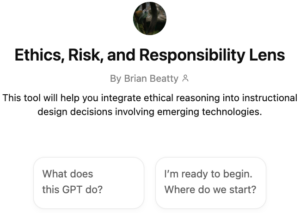
Try out the Ethics, Risk, and Responsibility GPT in the ChatGPT Store (requires a free or paid OpenAI account for ChatGPT access.) https://chatgpt.com/g/g-697b9f409a948191bc4d9dc374a0bb3e-ethics-risk-and-responsibility-lens
Change Type 2: New Capabilities Change What Is Possible
A second form of change occurs when new tools, resources, or capabilities become available.
This type of change is especially visible today as students gain access to generative AI, AI-enhanced design tools, multimedia creation platforms, and increasingly sophisticated learning technologies. But the underlying challenge is not new. Learners have always encountered new tools that expanded what they could do.
What makes this moment interesting is that new capabilities create both opportunities and risks.
A student discovers a new AI writing tool and can suddenly generate large amounts of text. Another finds Canva’s AI-powered design features and can create sophisticated visuals in minutes. A third uses NotebookLM to generate summaries, podcasts, and study materials from course resources.
The question is not whether these tools work. The question is whether they improve learning.
Students can easily become overwhelmed by new possibilities. They may spend more time exploring tools than learning concepts. They may add unnecessary complexity to projects, create overly long reports, or chase every new feature that appears. Cognitive overload, distraction, and misplaced effort can become unintended consequences of increased capability. From a cognitive load perspective, learners may devote mental resources to managing tools and information rather than engaging with the learning task itself (Sweller, 1988; Sweller et al., 2011).
In this moment, AI can serve as a reflective partner rather than a production tool. Learners can use AI to examine tradeoffs, compare alternatives, identify risks, and evaluate whether a new capability genuinely supports their learning goals.
New tools do not eliminate the need for judgment. They increase it.
The challenge is not keeping up with every new technology. The challenge is deciding which new capabilities deserve a place in the learning process.
Change Type 3: New Contexts Change What Application Requires
A third form of change occurs when students must apply what they know in a new context, for a new audience, or under different expectations.
This kind of adaptation is common in both education and professional practice.
A business student who is comfortable preparing marketing materials for corporate clients may need to present recommendations to a public agency responsible for regulation or funding. A scientist who is accustomed to communicating with researchers and grant reviewers may need to explain complex ideas to the general public. A classroom teacher may need to redesign lessons for an online environment or create professional development experiences for fellow educators.
In each case, the underlying knowledge remains important. What changes is the context in which that knowledge is applied.
The learner must decide what should remain stable and what must change. Which examples are appropriate for the new audience? What assumptions can no longer be taken for granted? How should the communication style, evidence, or instructional approach be adapted?
This is not simply a matter of translating existing work. It requires judgment.
AI can help learners analyze audiences, identify contextual differences, anticipate challenges, and explore alternative approaches. Rather than generating finished products, AI can support learners as they think through the implications of applying knowledge in a new setting.
Successful adaptation requires more than transferring knowledge. It requires understanding how context shapes what effective practice looks like.
Next, I encourage you to watch a short video about a student project team working through a series of changes with a selective use of AI support.
Example from Practice: Supporting Adaptation Through Reflection
One of the most useful roles for AI in this moment is helping learners think through the implications of change.
Suppose a student has been using a generative AI tool primarily for brainstorming ideas. Later in the course, that same student begins exploring questions of assessment, academic integrity, and learner agency. The student now faces a different question: Does this new understanding change how I should use the tool?
Or imagine a faculty member who discovers a powerful new AI capability that can generate learning activities in seconds. The challenge is not whether the tool works. The challenge is deciding how that capability fits within broader goals for student learning, engagement, and assessment.
In these moments, AI can help learners examine assumptions, compare alternatives, identify tradeoffs, and think through the consequences of different choices. The value lies not in the answer, but in the reasoning process.
Why This Works
The moment in the learning process: Learners encounter meaningful change after they have already developed understanding, applied knowledge, or worked through challenges. The change may involve new perspectives, new capabilities, or new contexts that require them to reconsider previous assumptions or practices.
The type of cognitive work required: Learners must interpret change, determine its significance, and decide whether adaptation is warranted. They must distinguish between changes that require action and those that do not. They must also decide what should remain stable and what should be modified.
The form of support provided: AI can help learners compare perspectives, analyze implications, explore alternatives, and reflect on adaptation strategies. Rather than making decisions for learners, AI supports the judgment and reflection required for thoughtful adaptation.
This form of support is particularly valuable because adaptation is rarely about finding a single correct answer. It is about making informed decisions in changing circumstances.
Educational researchers have described this capability as adaptive expertise. Whereas routine expertise emphasizes efficient application of established knowledge and procedures, adaptive expertise involves recognizing when circumstances have changed and adjusting one’s understanding, strategies, or actions accordingly (Hatano & Inagaki, 1986). Learners demonstrating adaptive expertise do not simply repeat what worked before. They examine new perspectives, evaluate emerging possibilities, and modify their approaches when conditions warrant.
The three forms of change discussed in this post, new perspectives, new capabilities, and new contexts, all require this kind of adaptive thinking. AI can support that process by helping learners interpret change, compare alternatives, identify implications, and reflect on possible responses. The goal is not adaptation for its own sake. The goal is thoughtful adaptation that supports continued learning and effective action.
Beyond Any One Course
The need to adapt extends far beyond formal education.
Professionals encounter new technologies, changing expectations, evolving regulations, and shifting social contexts throughout their careers. Faculty continually adjust their teaching in response to new evidence, student needs, institutional priorities, and emerging tools. Organizations adapt to changing markets, policies, and technologies.
In each case, success depends not simply on what people know. It depends on how effectively they adapt what they know when circumstances change.
That is why this learning moment matters. The ability to learn, reconsider, and adapt may be one of the most important capabilities learners develop.
Try This in Your Course
Think about a recent change that affected your teaching, learning, or professional practice.
Perhaps you encountered a new perspective that challenged an earlier assumption. Maybe a new technology expanded what was possible. Or perhaps you found yourself applying familiar knowledge in a new context or for a new audience.
Ask yourself:
What has changed?
Does this change what I should do?
How should I adapt?
Consider using AI as a reflective partner in this process. Rather than asking for answers, use it to explore perspectives, identify tradeoffs, surface assumptions, and examine possible responses. The goal is not to react automatically to change. The goal is to adapt thoughtfully.
Key Insight
The goal is not to react to every change. The goal is to understand which changes matter and adapt thoughtfully.
Looking Ahead
In the final post of this series, I will explore the last moment in the AIMON learning arc: how AI can support learners as they deepen expertise, refine performance, and continue learning beyond initial competence.
References
Gottfredson, C., & Mosher, B. (2011). Innovative performance support: Strategies and practices for learning in the workflow. McGraw-Hill.
Hatano, G., & Inagaki, K. (1986). Two courses of expertise. In H. Stevenson, H. Azuma, & K. Hakuta (Eds.), Child development and education in Japan (pp. 262–272). W. H. Freeman.
Mayer, R. E. (2021). Multimedia learning (3rd ed.). Cambridge University Press.
Sweller, J. (1988). Cognitive load during problem solving: Effects on learning. Cognitive Science, 12(2), 257–285.
Sweller, J., Ayres, P., & Kalyuga, S. (2011). Cognitive load theory. Springer.
[…] The goal is not to react to every change. The goal is to understand which changes matter and adapt thoughtfully. View blog post. […]